







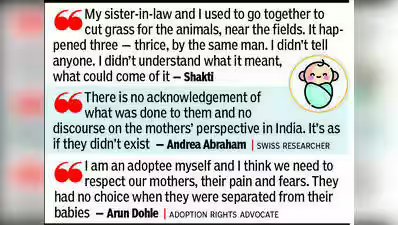
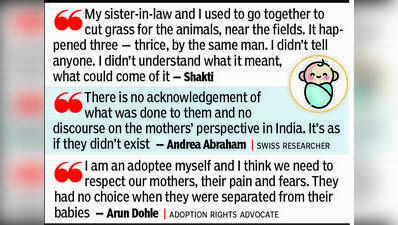
Pune: Shakti remembers walking behind her father on dusty tracks near her village on the outskirts of Pune in the early 1980s—the endless green fields stretching into the distance the day her childhood was taken away.“I didn’t know I was pregnant until I was eight months along,” says the 55-year-old, whose name has been changed to protect her identity. It was her sister-in-law who first noticed the pregnancy. Shakti was 15 when she was raped. “It happened near the sugarcane fields—three times, by the same man, a local farm worker. I didn’t tell anyone. I didn’t know what would come of it.”Her father, devastated and shocked, turned away from her. “Vahini took me to a local doctor, then to a gynaecologist, then to Sassoon Hospital, and finally to a home where I delivered a baby girl.” Around that same time, her father died.“After the birth, they gave me medicine to dry up my milk,” she recalls. “My brother came to take me back. He said the baby would bring shame, that people would ask questions.” Jyoti (name changed) was placed for adoption.Shakti returned home after two months, but never forgot her daughter.Shakti was married off to an older widower, with children almost her age. At 16, she became mother to another daughter. When her husband died, she had to leave home again. Shakti survived through domestic work and odd jobs, raising her child alone.Her secret was buried deep in her bosom. “I never told anyone but my sister-in-law about what happened to me,” she says. “But I always wondered if the child was alive, where she was, what had become of her.”What happened to her first daughter?In Germany, Jyoti was being raised by a loving adoptive family. At 15, her curiosity to know her origins led her to begin a search for clues hidden in adoption papers and institutional records. She came across adoption-rights advocates Anjali Pawar and Arun Dohle of the Adoptee Rights Council, who helped trace her birth mother.The trail ended where it had begun decades earlier. Shakti says, “I didn’t want to be found at first.” Memories would resurface, and her “younger daughter still doesn’t know about her half-sister.” But Shakti’s sister-in-law stepped in. Then fear gave way to hope. In 2016, Jyoti arrived in India and the reunion took place with discretion.Jyoti clearly remembers the day. “My mother was in a flower-printed sari and had a large red bindi.” Beside her stood Shakti’s vahini, her confidante of many years. Seated across Shakti was the daughter she had thought of every day of her life for 30 years. Mother and daughter broke down in tears.Shakti gently caressed her daughter’s head and wiped off her tears with her pallu as the two embraced. “It was the first time in my life someone truly knew. I didn’t have to hide anymore…,” she says.Yet not every story ends this way. For instance, Baani (name changed) — her daughter was given up for adoption after her family refused to accept an inter-caste relationship. Decades later, the daughter traced her to Nagpur. Baani blessed her daughter but asked that they never meet again. She feared the taboo of being an unwed mother. She died in Oct 2023.Then there was Dhanalakshmi of Chennai who spent decades grieving her two lost sons to unconsented adoption. She died last month, not long after reuniting with one of her sons.