









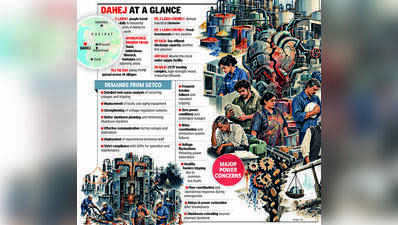
Dahej is not just another industrial estate on Gujarat’s Golden Corridor—it is one of the key power centres of the state’s economy. Spread across a strategic stretch of the corridor and anchored by the country’s most developed Petroleum, Chemicals and Petrochemicals Investment Region (PCPIR), Dahej today hosts more than 400 chemical, petrochemical, pharmaceutical, engineering and export-oriented units, with a combined annual turnover of over Rs 2 lakh crore.But the industrial powerhouse is facing a growing power problem. Frequent outages, tripping, breaker failures, voltage fluctuations and delays in restoration have disrupted production, with industry representatives estimating losses of around Rs 100 crore every month. The disruptions have raised concerns at a time when projects involving investments of more than Rs 1 lakh crore are planned in the region.Industrialists have urged Gujarat Energy Transmission Corporation Ltd (GETCO) to strengthen the transmission and distribution infrastructure, replace aging equipment and improve operational coordination. They said inadequate technical manpower, delayed response, poor planning and communication during breakdowns are adding to the problem.“Last month, we faced four major outages — on Sept 13, 16, 19 and 23 — resulting in losses of more than Rs 200 crore. The outages lasted between four and 10 hours,” said Sunil Bhatt, president of Dahej Industries Association (DIA). “Besides major outages, we are facing frequent breaker failures, repeated tripping, zero-power conditions, voltage fluctuations, delayed restoration and shutdowns extending beyond the planned duration. We have raised these concerns with GETCO several times, but things are not improving.”The stakes are high because Dahej produces basic chemicals and materials that feed industries across the country and overseas. With the PCPIR, SEZ and other industrial initiatives attracting companies of national and international repute, the region is also preparing for another phase of expansion.According to industry sources, Dahej’s major power supply comes through the 220kV substations at Suva and Dahej, besides a network of 66kV substations at Dahej, Vadadala, Sambheti, Jolva, Luna, Galenda, Suva, Atali, Ambheta and Bhensali, among others. These are connected to major power sources from Vagra, Haldarava, Kosamba and another source.“Last month, there were disruptions in one power source after another for different reasons, leaving nearly half of Dahej without power. There are serious concerns over relay settings at some of these sources, because faults elsewhere can affect Dahej even when the industrial area itself is not responsible,” the sources said.For chemical industries, a power interruption is not simply a production issue — it can become a process and safety risk. Most plants run continuous processes, and an unexpected trip can disrupt an entire batch, damage equipment and create hazardous conditions.“Apart from around 200 large units, Dahej has nearly 200 small and medium industries. Chemical processes are continuously under way at these units. Power failures can result in an entire batch being lost, causing losses running into crores,” said Baldev Ahir, secretary, DIA. “An interruption can also increase the risk of gas leakage and other industrial hazards. With new units coming up and existing plants operating at high capacity, Dahej needs robust, uninterrupted and quality power,” he added.Dahej has invested heavily in supporting industrial infrastructure. The region has a 400 MLD round-the-clock water facility, a 100 MLD desalination plant, India’s first chemical smart estate, 40 MLD CETP and a 90 MLD effluent sea-discharge pipeline. Industrialists say power reliability needs to match these facilities.“We are satisfied with govt and various departments and agencies for creating major infrastructure for water, effluent discharge, roads and other facilities. But without quality power, we cannot optimally use this infrastructure in line with the Viksit Bharat-2047 vision,” Bhatt said. “With chemical projects, including those linked to the EV ecosystem, coming up, power infrastructure needs advance and modern planning. GETCO should regularly engage with industry leaders and plan for future demand because power is the basic requirement for production.”The impact of an outage can also linger long after supply is restored. DIA power committee chairman Mahendrasinh Rana said some plants, particularly polyester, resin and similar units, take 24 to 72 hours to return to stable operations after a major power interruption or voltage fluctuation. He said such disruptions were making some companies cautious about expanding capacity.Vyanu Vyas, director of a major Dahej industrial unit, said aging infrastructure was another concern. “Some equipment is around 15 years old and needs to be replaced. Infrastructure at several locations has deteriorated and could cause disruptions. Even a 20-millisecond trip can result in losses of crores of rupees. Our unit incurs annual losses of around Rs 15 crore to Rs 20 crore because of power issues. A single major disruption can cause Dahej industries losses of Rs 50 crore to Rs 100 crore,” he said.For an industrial region to attract another Rs 1 lakh crore-plus investment and keep running on full power, industry leaders say ensuring a resilient power grid, stronger protection systems and faster fault restoration will be critical.