







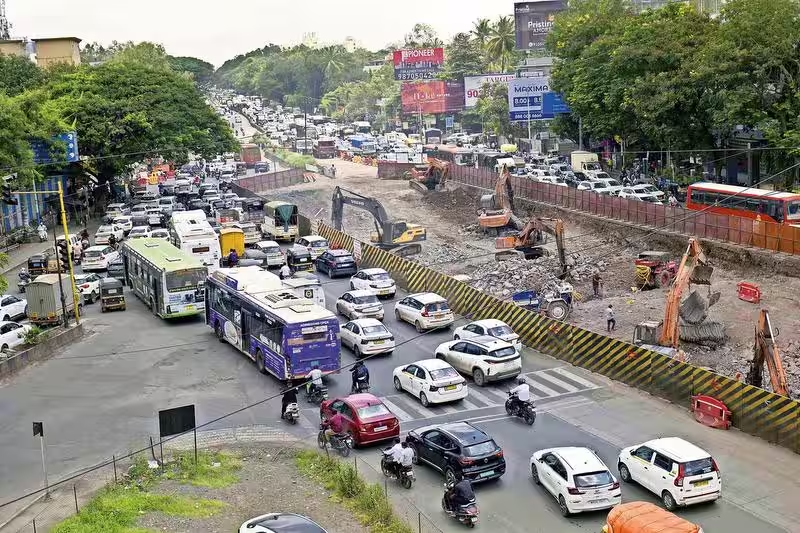
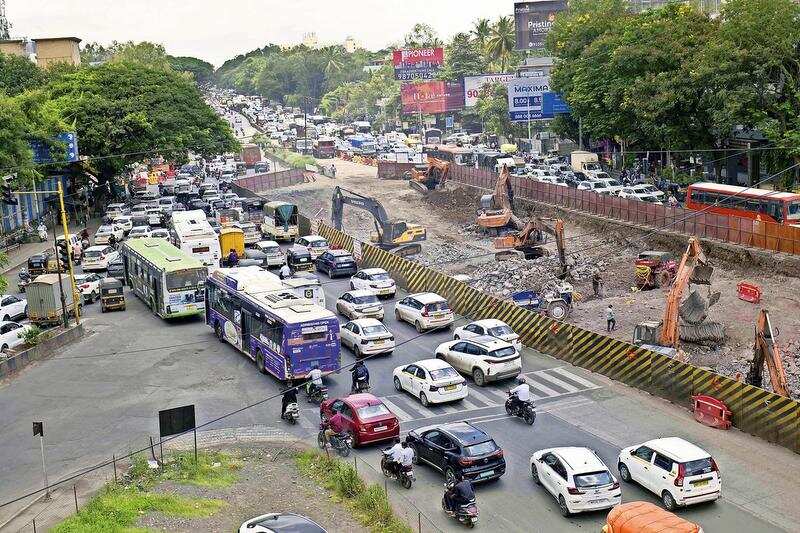
Pune: At 8.30am, the distance between Shastrinagar and Golf Course Chowk is no longer measured in kilometres. It is only measured in minutes spent staring at the brake lights of the vehicle ahead.Two-wheelers squeeze through gaps, cars edge towards barricades and buses are forced to negotiate a narrow carriageway. Traffic spilling out from Nagar Road finds its way into internal roads, while commuters headed towards Kharadi deal with a chain reaction that stretches across the eastern corridor.The traffic department estimated that in 2025, nearly 2 lakh vehicles used the Nagar Road corridor every day. An updated Comprehensive Mobility Plan also recorded over 2 lakh vehicles a day at the Janak Baba Dargah Chowk counting point on Nagar Road last year, underscoring the scale of traffic being funnelled through this corridor. On a route with such heavy vehicular movement, even a small reduction in usable road space can trigger congestion up to several kilometres away.The latest trigger for the crisis is the ongoing construction of the Shastrinagar grade separator and flyover. But for residents of Yerawada, Shastrinagar, Kalyaninagar, Kharad, Vimannagar and Wadgaonsheri, the problem didn’t begin with construction barricades. The mess is a result of several traffic interventions converging on one of Pune’s busiest corridors — the earlier signal-free system, U-turns, removal of road medians, BRTS dismantling, utility work, and construction-related narrowing of road space.“Exiting Kalyaninagar via Shastrinagar is a nightmare. With oncoming traffic and only a left turn allowed, vehicles pile up all the way till the Yerawada signal. It took me 15 minutes just to get from Sainagari to Gurunanak Chowk instead of the usual four minutes recently on a weekday morning. I finally turned back to avoid getting stuck. Kalyaninagar is jammed on all three access points,” said area resident Kamal Thadani.Years in the makingThe Shastrinagar project has been in the making since 2024. Pune Municipal Corporation (PMC) had initially planned a flyover-cum-subway, but the design evolved after changes on the ground, including the dismantling of the BRTS corridor. PMC also needed the Archaeological Survey of India’s (ASI) clearance as the project is close to Aga Khan Palace. This was obtained only in 2024. The proposal is now a roughly 750m, six-lane grade separator between the Aga Khan Palace side and Gunjan Chowk, along with a roughly 700m, four-lane flyover between Aga Khan Palace and Golf Chowk at a total cost of Rs81.9 crore.The stated aim of the project, which has a March 2027 deadline, is to take traffic away from the junction and reduce the need for vehicles to stop and cross at Shastrinagar junction. Additional commissioner of police Manoj Patil reiterated that the Shastrinagar construction work’s purpose is to ease the future of Nagar Road travel. “In 2025, traffic police introduced a signal-free system between Gunjan Chowk and Kharadi, closing several junction movements and introducing U-turns. At one stage, four U-turns were introduced along the roughly 9km-stretch. Our analysis showed improvement in traffic speed.”Residents pointed out that the construction plan should be treated as a traffic-management exercise, not merely a civil engineering project. “Nagar Road is already under pressure. Now, motorists are being sent through smaller roads and loop roads. These roads were never designed to handle this volume of traffic during office hours,” said Kalyaninagar resident Animesh Puri.Puri was referring to the diversions in place that send traffic from Shastrinagar towards Golf Course Chowk through Gunjan Chowk and the loop road near River View Society. Police have warned that the situation will continue to remain challenging for two to three months while the grade separator work is under way.“That is precisely where residents say the planning is falling short,” said Roshni Mahapatra of the Kalyani Nagar Citizen’s Forum. “For us, this is not simply a traffic inconvenience. It changes how the neighbourhood functions. Children have to leave earlier to get to school, and school van operators have to build additional time into every route. Office buses lose their schedules.”No solutions in sightEmployees who want to reach Kharadi’s IT parks can never correctly predict their arrival times. College students travelling between campuses and hostels also have to factor in an uncertain journey.Venkatesh Jaisinghe, a gig worker said, “We lose productive time when a short trip becomes a prolonged wait. The corridor is also used by people travelling to Pune airport, hospitals, schools, commercial establishments and residential areas. Nagar Road traffic comprises far more than just office-hour rush.”Vimannagar resident Nasreen Madhani described the ripple effect: “The traffic backs up much before Shastrinagar. If one junction gets blocked, the congestion spreads towards Kalyaninagar, Vimannagar and Wadgaonsheri.”The problem became particularly acute for pedestrians as the closure of median openings meant that people often had to cross wider stretches of road or negotiate U-turn locations.In 2025, PMC began removing unused BRTS bus stops and dividers from a 3km-stretch between Somnathnagar and Kharadi Juna Naka, claiming the infrastructure was obstructing traffic movement. However, the additional road space created by this dismantling has now partly been consumed by construction activity.Wadgaonsheri resident Jacob Jose said the problem was also one of poor lane discipline among Pune’s vehicle users. “The diversion boards are there, but when hundreds of vehicles reach the same point together, people start changing lanes and squeezing into whatever gap they can find. This creates another bottleneck.”Another worrying consequence of this mess is the return of wrong-side driving. In Aug, motorists were reported using the wrong carriageway for 3-4km between Gunjan Chowk and Ramwadi to escape the congestion created by the Shastrinagar diversion. A plethora of choicesCorporator Yogesh Mulik said there were already several possible links in the wider road network, but many were either under construction, awaiting completion or required coordination between PMC, traffic police and other agencies. “One proposal is a road connection from HDFC Circle in Kalyaninagar to Gunjan Chowk, which PMC has indicated could provide another exit towards Wadgaonsheri and reduce the dependence on Nagar Road. Another road connecting Kalyaninagar and Wadgaonsheri near Nyati properties has also been proposed. An additional lane between Koregaon Park and Kalyaninagar has been planned to improve movement between the two neighbourhoods,” Mulik further said.There is also a proposed road from Gunjan Chowk to Kalyaninagar running under the Metro line, besides an underpass proposal linking Gunjan Chowk with Airport Road. These links could become particularly important during the construction phase because they would give local traffic an opportunity to avoid the main Nagar Road bottleneck.Another option that has previously been raised by local residents and commuters is to open usable stretches beneath the Metro alignment wherever technically feasible before implementing major closures.“Traffic police and PMC should have opened the road from Gunjan Chowk to Kalyaninagar beneath the Metro line before implementing the diversion. This alternative would have reduced the chaos,” said Jaffar Iqbal, secretary of Team Swachh, Kalyani Nagar.‘Not asking for much’For now, residents have asked for something less ambitious — keep the existing network moving while the new one is being built.“Nobody is against the grade separator. We want the project completed. But two or three months of chaos during peak hours will be difficult for thousands unless the traffic plan is strengthened,” said Kalyaninagar resident Poonam Singh.The history of Nagar Road shows why that demand matters. Traffic problems here have repeatedly shifted instead of disappearing — first from signals to U-turns, then from BRTS bottlenecks to median closures, and now to construction diversions.Nagar Road-Wagholi ward officer Sanjay Pol said public transport also has a role. “The Vanaz-Ramwadi Metro corridor already serves parts of the area, but Kharadi and much of the eastern employment belt remain dependent on road transport. Pune Metro’s next-stage plans include an elevated road-cum-Metro extension from Ramwadi towards Kharadi and Wagholi, but that is a longer-term solution,” Pol said, “We are looking at easing the situation as the construction work is underway to relieve commuters in the present situation,” he further added.Vimannagar resident Sameer Raichandani said: “The grade separator may eventually provide the uninterrupted movement the corridor needs. But, for the residents living, studying and working along the Gunjan Chowk-Kharadi belt, the measure of the project will not be the length of the flyover or the number of lanes on the drawing board.”