






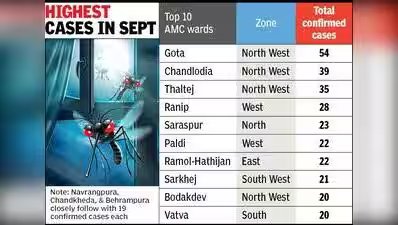
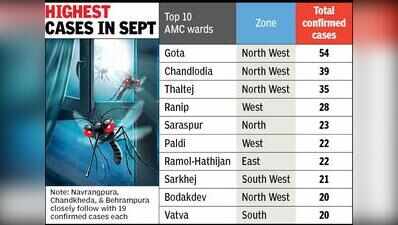
Ahmedabad: Dengue has raised its ugly head in the city, with Sept being a particularly severe month when infections surged to a worrisome high. From Sept 1 to Sept 27, the city recorded 640 cases, according to data released by AMC’s health department on Tuesday. These cases constituted 51.1% of the roughly 1,228 dengue cases reported between Jan 1 and Sept 27.The lull in monsoon last month created ideal conditions for mosquitoes to breed, even as the civic body carried out checks to stamp down sites harbouring larvae.Besides dengue, the city during this period also recorded 103 cases of simple malaria, 27 cases of falciparum malaria and seven cases of chikungunya.An AMC official said, “The civic body has taken steps to curb mosquito breeding. Commercial units, especially construction sites, are being inspected. Sites having conditions conducive for mosquitoes to breed are being sealed. Most of such spots are in areas with high construction activity. AMC is taking all precautionary measures.”The official added, that dengue cases are particularly high in Gota, Jagatpur, Chandkheda, Bodakdev and Thaltej. “Cases are also being observed in Vastral, Lambha and Nikol. Open plots where rainwater had remained stagnant for an extended period are being surveyed. Work is underway to drain this water and spray insecticide. AMC is running public awareness campaigns alongside fumigating residential and commercial areas,” he said. AMC is also gathering dengue case data from every private hospital. Those failing to submit this data will be issued notices, the official said.“This year, we have seen a modest increase in dengue cases among children. Most children respond well to supportive care, particularly adequate hydration. As a precaution, children should wear full-sleeved clothes to reduce exposure to mosquitoes and to prevent infection,” said Dr Rajan Doshi, a paediatrician in Gandhinagar.According to AMC, from Jan 1 to Sept 27 this year, Ahmedabad also recorded 419 cases of simple malaria, 74 cases of falciparum malaria and 14 cases of chikungunya. Furthermore, 4,114 cases of gastroenteritis (diarrhoea/vomiting), 600 cases of jaundice and 1,655 cases of typhoid were reported. Between Sept 1 and Sept 27, there were 194 cases of gastroenteritis, 68 cases of jaundice and 236 cases of typhoid. During the same 27-day period, 46,080 water samples were collected for chlorine testing, of which nine returned a ‘chlorine nil’ report. Additionally, 6,585 water samples were collected for bacteriological testing, resulting in 19 samples being declared unfit for consumption.