








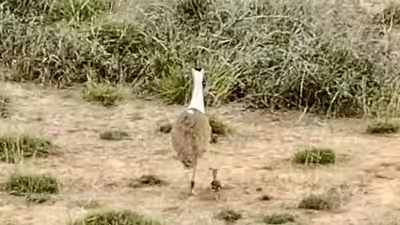
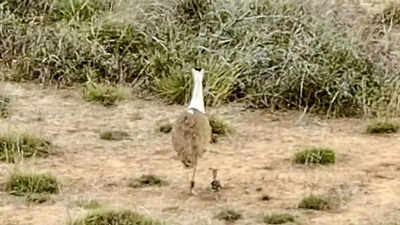
JAISALMER: Wildlife and Great Indian Bustard (GIB) experts have expressed disappointment over the disappearance of the GIB chick that hatched in Naliya (Kutch), Gujarat, from an egg transferred from Jaisalmer. They have demanded a thorough investigation and called for the truth behind the incident to be brought to light. Experts said this initiative had the potential to be a “game changer”, but its first failure has dealt a setback to efforts to re-establish the GIB in Gujarat. Notably, more than 50 guards had been deployed to protect the newborn chick. Even the access routes to the area were sealed. However, it is suspected that after the chick became capable of limited movement, it may have fallen prey to a wild animal. According to available information, there are only three female GIBs in Kutch, Gujarat, and natural breeding had almost come to a halt. To revive the species, scientists selected a fertile egg from the GIB breeding centre at Sam in Jaisalmer. The egg was transported in a portable incubator over a distance of about 770 km to Naliya (Kutch) on March 21, 2026, in a continuous 19-hour journey. It was then placed in the nest of a female GIB using a technique known as “surrogacy” or “jumpstart”. When the chick hatched on March 26, 2026, it was seen as a major conservation success. After the chick’s birth, the Gujarat government and forest department treated its protection as a top priority. Around-the-clock surveillance was maintained with 50 guards, access roads were sealed, and watchtowers were used for monitoring with binoculars. However, after April 18, the chick was no longer seen with the GPS-tagged female GIB. Sources in the forest department indicated that there may have been gaps in the security perimeter. It is suspected that a predator such as a dog, jackal, or wild cat may have entered through these gaps and preyed on the 26-day-old chick. No remains have been found so far, but after being missing for so many days, the chances of survival are considered very low. Wildlife expert and former chief of the Wildlife Institute of India, Dr M.K. Ranjitsinh, said that the Great Indian Bustard should be reintroduced across all its former habitats, including Karnataka, Maharashtra, Gujarat, Madhya Pradesh, and other parts of Rajasthan. He stated that the egg transfer and hatching effort was scientifically sound and appropriate, but it is important to learn from this incident to avoid such setbacks in the future. He emphasised that the truth must come out, as the GIB is a national heritage species, not confined to any single state. He added that although the initiative could have been a game changer, its initial failure is deeply disappointing. Dr Sumit Dookia, senior wildlife biologist and associate professor at GGS Indraprastha University, Delhi, said: “It has now become evident that we have lost the GIB chick, which was born through rigorous scientific efforts and consistent care by the project team. The natural world is a little harsh, and mortality rates of GIBs at a young age are higher than in adults. The area seems to have many meso and small carnivorous animals.” He said that despite the current uncertainty, the programme itself remains a resounding success for several reasons. This “Operation Egg Transfer” proved that complex inter-state surrogate breeding is possible. Scientists successfully bypassed the biological limitation of Gujarat’s all-female wild population. Dookia added that there is now a visible, scalable future. The GIB Conservation Breeding Centre at Jaisalmer currently houses 78–79 birds, including 11 new chicks this season, providing a strong foundation for future rewilding efforts. “Every conservation attempt—regardless of the immediate outcome—provides critical data on habitat security and monitoring protocols that will protect the next generation of hatchlings,” he said. As the search continues, the focus remains on the broader recovery of the species, viewing this event not as a finality, but as a calculated step to build a resilient GIB population outside Jaisalmer. Former Rajasthan Chief Wildlife Warden R.N. Mehrotra said that conservation efforts are always full of challenges and obstacles, but he remains confident of success in future attempts. He noted that a fairly successful captive breeding population now exists, the technology has matured, and the primary requirement is to ensure a safe and suitable habitat for the species. B.M. Gupta, Deputy Conservator of Forests at Desert National Park, Jaisalmer, said that while efforts were made to protect the chick, certain risks in the wild cannot be completely eliminated. There is a possibility that it may have been preyed upon by predators such as jackals or foxes. He added that confirmation is still pending and search efforts are ongoing. Since the chick was not kept in captivity or an enclosure, controlling its movement was difficult. Typically, a GIB chick becomes capable of sustained flight and relatively safer only after about three months.