







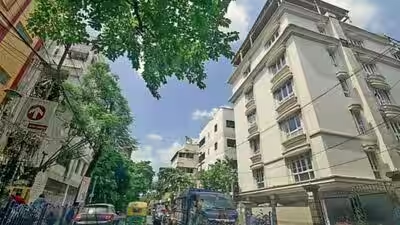
From bungalow colony to premium residential address, New Alipore has changed dramatically — but its parks, clubs, puja committees and para culture continue to bind the neighbourhood togetherOn a weekday morning, New Alipore can be deceptively quiet. Retired residents walk through tree-lined lanes, schoolchildren hurry to classes, and shopkeepers pull up shutters.By evening, the neighbourhood changes. Cafes fill with students and young professionals, restaurants get busy, coaching centres spill over and the old para adda competes with a growing coffee culture.That ability to accommodate different generations may be New Alipore’s defining feature.Spread between the railway tracks near Majerhat and Tollygunge, and bounded by BL Saha Road, Alipore, Tollygunge Circular Road, Diamond Harbour Road and Behala, New Alipore is among south Kolkata’s best-known residential addresses.But unlike many of the city’s older neighbourhoods, it was not allowed to grow organically. It was conceived as a planned residential suburb in the 1950s to accommodate Kolkata’s expanding population.Its numbered blocks, relatively broad roads, parks and spacious plots gave it a distinct character. The India Government Mint, which predates the residential colony, remains one of its prominent landmarks.For the first generation of residents, New Alipore represented a new way of living.
The bungalow years
The early identity of New Alipore was closely linked to its detached houses. Families moved into independent homes with verandahs, gardens and open spaces — not the grand colonial mansions of old Alipore but modern post-Independence houses that reflected the aspirations of the growing middle- and upper-middle classes.Doctors, lawyers, academics, govt employees, businessmen and other professionals formed much of the early population. Some came from older parts of Kolkata; others from families displaced by the Partition.“When we came here, New Alipore was a new colony. There were fewer houses and plenty of open spaces. Most families knew each other, and the club and para puja were at the centre of social life. The biggest change has been the disappearance of independent houses and gardens.”— Sameer Mukherjee, septuagenarian engineerLarge houses have increasingly given way to apartment blocks. Gardens have shrunk, plots have been subdivided and redevelopment has become a familiar sight.Priyanshu Maiti, a resident, said the demographic change was equally visible.“Earlier, you knew almost every family in your block. Now, there is much more diversity, which is good, but the old para culture has become less intense.”
From bungalow colony to premium address
The disappearance of the bungalow is closely tied to another transformation: the rise in land value.New Alipore today is a premium residential market, helped by established schools, hospitals, markets, parks, clubs and restaurants. Rail and metro connectivity has further strengthened its appeal.The average asking price for a multi-storey apartment in New Alipore is anything between Rs 12,000-Rs 13,500 per sqft. Premium projects command even more.“The value of land has changed the neighbourhood. A large house earlier used by one family can become a multi-storey project.”— Gaurav Agarwal, residentThe redevelopment has also changed who lives here — from a self-contained Bengali middle-class colony to a cosmopolitan residential neighbourhood.
Para adda & coffee culture
The change is perhaps most visible in the way people socialise.The old New Alipore revolved around clubs, parks, tea stalls, markets and neighbourhood gatherings. A club was often the centre of football, cultural events, festivals and informal social life.Though that culture has not vanished, it has acquired new companions.Cafes have appeared alongside traditional snack shops and restaurants. Students, freelancers, young professionals and couples now occupy tables instead of gathering at tea stalls or club rooms.The result is a locality where an elderly resident can have an adda over tea while, a few lanes away, youngsters bond over coffee.
Where football meets Durga Puja
Few institutions capture New Alipore’s sporting and cultural identity as clearly as Suruchi Sangha.Founded in 1952 as a sports and cultural club, it has retained a football tradition while its Durga Puja has become one of the city’s major attractions.The large-scale theme puja sits alongside the intimate neighbourhood celebrations that remain rooted in the para tradition.Since the change of govt, the growing political role of clubs and puja committees has periodically triggered disputes over management and identity. But, even now, the puja remains at the heart of New Alipore.“Puja has always been more than four days of worship here. It is when the whole neighbourhood comes together. But the scale has changed. There is more money, sponsorship and competition now, and politics has become part of conversation.”— Kanak Chatterjee
A cultural address
New Alipore’s cultural identity extends beyond its pujas.Film-maker Tapan Sinha lived here for decades while the neighbourhood has also been associated with personalities from sports, academia and public life.School functions, college programmes, theatre, music, literary events and exhibitions have long been part of everyday life.
Better connected, more commercial
Transport has altered New Alipore’s relationship with the rest of Kolkata.New Alipore and Majerhat railway stations have long provided suburban rail links, while Diamond Harbour Road, BL Saha Road, Tollygunge Circular Road and James Long Sarani connect it to Alipore, Behala, Tollygunge, Taratala and the southern suburbs.This connectivity has encouraged commercial growth.Houses now sit alongside restaurants, clinics, tuition centres, salons and retail outlets. However, this expansion has brought another concern.
The darker side
Police investigations in recent years have exposed the misuse of commercial or residential premises for fraudulent call-centre operations.Though such cases are part of the wider cybercrime problem in south Kolkata, for residents, the cases underline a new reality: as property use becomes more mixed, the distinction between a traditional residential neighbourhood and a commercial hub is becoming less clear.“The residential character remains strong, but there is also much more commercial activity. That means houses and rented premises are being used in different ways.”— Abhijit Bhowal, resident
Three generations, one neighbourhood
And yet, New Alipore has retained something many rapidly changing parts of Kolkata have lost — a strong sense of place.The block numbers still matter. So do the parks, school gates, markets, clubs and puja committees.An elderly resident remembers when a block had only a handful of houses.A second-generation resident remembers playing football at the triangular park.A younger resident may know the same neighbourhood through a favourite cafe.All three versions of New Alipore coexist.