








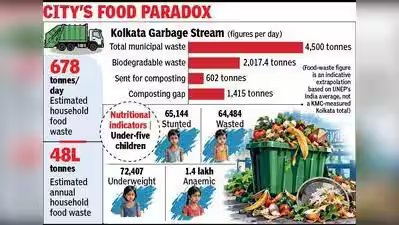
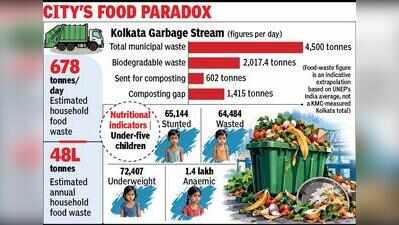
Kolkata: Kolkata may be wasting nearly 680 tonnes of household food every day, even as food insecurity and child undernutrition persist across vulnerable sections of the city.The figure is an indicative estimate derived from the UN Environment Programme’s Food Waste Index 2024, which puts India’s average household food waste at 55kg per person annually. Applied to Kolkata’s population of more than 45 lakh, that works out to roughly 2.48 lakh tonnes a year, or 678 tonnes every day.And that is only household waste. Once discarded food from weddings, festivals, restaurants, hotels and social and political functions is added, the actual volume could be far higher.“This is an extrapolation, not a measured Kolkata figure. But even this conservative estimate shows the scale of the problem. The real number, if institutional and event waste is counted, may be far higher,” said a senior bureaucrat researching food waste.The estimate also exposes a major data gap. KMC handles around 4,500 tonnes of municipal waste daily, but there is no regularly published citywide figure showing how much edible food is discarded by households, markets, restaurants, hotels and events.Organic waste already makes up a huge part of Kolkata’s garbage stream. A National Green Tribunal order of July 22, citing Bengal’s compliance report up to March 2026, recorded 2,017.4 tonnes of biodegradable waste daily in Kolkata. Of this, only 602 tonnes was being taken for composting, leaving a gap of around 1,415 tonnes a day.The waste numbers sit uneasily beside Kolkata’s nutrition indicators. A NITI Aayog-IFPRI district nutrition profile based on NFHS-5 data estimated that among Kolkata’s under-five children, around 65,144 were stunted, 64,484 wasted and 72,407 underweight, while nearly 1.43 lakh were anaemic.“These are 2019-20 estimates and cannot be treated as today’s hunger count, but they show that nutritional deprivation remains a serious concern,” said child-nutrition worker Ashima Haldar.A separate 2019 community study involving 257 mothers and under-five children in a Kolkata slum found 72.4% of surveyed households food insecure. Jayanta Dasgupta, a doctor, said the study could not be extrapolated to the whole city, but added that “the coexistence of food waste and nutritional deprivation is deeply disturbing”.In July, state UDMA minister Agnimitra Paul announced a plan to collect safe surplus food from hotels, restaurants and social functions, preserve it through a cold chain and redistribute it among economically disadvantaged people.Food and nutrition expert Amiya Mukhopadhyay said redistribution could help but was no substitute for tackling the root causes.“Hunger is fundamentally an issue of access and affordability. Safe surplus food can prevent waste and offer immediate relief, but malnutrition is also linked to dietary quality, sanitation, disease and maternal nutrition. It requires sustained improvements in income, healthcare, nutrition and social protection,” he said.