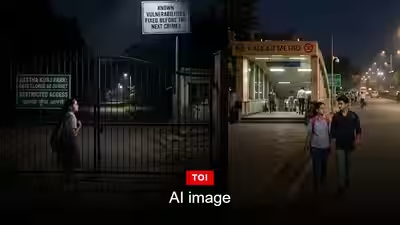








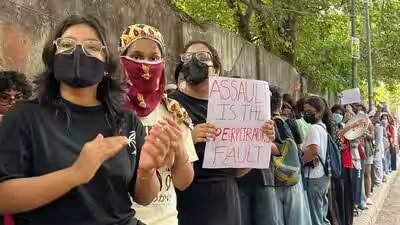
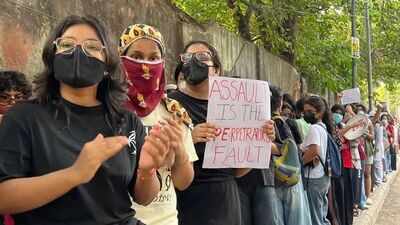
At 7pm, the sky over Delhi usually settles into a dusky purple, marking an hour that should belong to anyone looking to unwind. An evening walk.A coffee with a friend. A drive home after work. For the 17-year-old girl who went to a park on her birthday evening and was reportedly gang-raped, that leisurely walk turned into a nightmare. Barely a few kilometres away, something inside me tightened into a familiar knot.An evening walk in a well-lit park should be unremarkable. Instead, my brain starts doing the calculations almost without permission. Who is walking behind me? Why has that man slowed down? Is that the quickest route back? Should I call someone? Every footstep behind me is a reason to tense up. Every man crossing my path is someone I instinctively assess before I even realise I am doing it.When returning from work every evening, the moment the door of my cab thuds shut, my first instinct is to pull out my phone and share my live location with my family. Nobody asked me to. I do it automatically, leaving a silent digital breadcrumb just in case I don’t make it to my destination.This isn’t a rant. It is fatigue.The constant preparation for something that may never happen, but that we have been taught could happen at any time.We, the women of Delhi, are tired of the quiet list of instructions that follow us everywhere. Don’t go out after dark. Don’t walk alone. Share your location. Call when you reach. Stay alert. Keep your phone charged. Be careful about what you wear. Be careful about who you trust.The responsibility for staying safe keeps being handed back to us. We are expected to anticipate danger, avoid it, document it. Meanwhile, the spaces themselves remain much the same.So perhaps the question should not only be how we can teach women to protect themselves, but why women have to be constantly taught to protect themselves in the first place.Safety cannot begin and end with a “pink police booth,” a “pink force patrolling near a school, park or metro station” or “restricted entry to parks after sunset”. It has to extend to the way public spaces are designed and monitored. Are there blind spots? Is there adequate lighting? Can a woman see who is around her? Can she get help quickly? And when someone uses real or fake authority to intimidate or harm another person, is there swift accountability?I want to reach a point where getting into a cab at 7pm does not automatically trigger the thought, “I should share my location.” Where sitting in a park does not require an assessment of every man who walks past. Where looking out of a cab window can just mean looking out of the window.The year will change. The capital will get more flyovers and metro lines. But for how many more years will women have to live with a curfew in their heads?