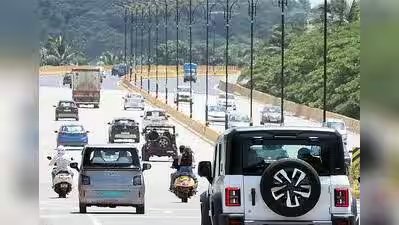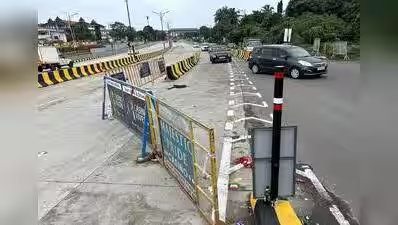








Panaji: “A six-lane over a four-lane road, it is a marvel,” declared Union minister for highways Nitin Gadkari on Sept 9, standing on the six-lane elevated corridor in Porvorim, minutes after its inauguration.He had no idea yet that the Rs 641 crore project, fully funded by his ministry, would soon come under intense public scrutiny. When the corridor opened to traffic on Sept 11, two lives were lost in a fatal crash, just metres from where Gadkari had stood two days earlier.Early warning signsFor some engineers who watched the project take shape from close quarters, the accident did not come entirely as a surprise. They say some of the problems were visible much before the first vehicle rolled onto the elevated road.“The highway was to be constructed for 80 to 100kmph speed. But during the early stages of the work, the contractors, RRSM Infra, pointed out that the curvature was not right to achieve that kind of speed. They put the possible speed limit at 70kmph. Eventually, it was limited to 65kmph for safety,” an official said.The contractors had also identified the stretch near Dr Pinto Rosario Hospital as a possible point where the flow of vehicles could be affected.The concerns go back even further to the project’s origins. When highway expansion work began in Goa around 2016, the Porvorim stretch was part of a single project from Karaswada to Bambolim. The Porvorim section was then estimated at around Rs 250 crore.“But the rest of the work began, and this was kept on hold. Some said it is due to the matter being in court over a land dispute with residents. The same project was awarded much later at a much higher cost for reasons not clear,” said an engineer familiar with the project.Work on the project by Rajasthan-based contractor RRSM Infra eventually began only in April 2023.No room for rampsBut the biggest challenge, engineers say, was one motorists would only discover once they got behind the wheel—how to enter, leave and merge into traffic on a road where there was simply not enough space to provide conventional ramps.Right from the planning stage, engineers said, up and down ramps could not be provided because of space constraints.“The consultants from outside Goa drew up the DPR in close consultation with then PWD principal chief engineer, and the project was entirely designed based on this consultant’s recommendations. No up and down ramps were designed right from the start and so the idea of slipways for vehicles entering and exiting from service roads came into being,” an official said.Six to four in 300mNow, the most uncomfortable question is how traffic from a six-lane elevated road is expected to merge into a four-lane Atal Setu within a distance of only around 300m.The difference in speed limits adds another layer of difficulty. Vehicles can travel at up to 65kmph on the elevated corridor, while the limit on Atal Setu is 50kmph. For a motorist approaching the merge, that leaves little room for hesitation or error.Scientist and state govt adviser professor Nandakumar Kamat has also raised questions about the difference in lane widths. In a letter to PWD principal chief engineer, he pointed out, “While a 3.50m lane aligns with the standard Indian Road Congress (IRC) design for multi-lane roads, it is considered tight for maximum-width heavy commercial vehicles operating at a higher speed of 65kmph. Because side-mirror extensions are excluded from the official 2.6m vehicle width, two heavy vehicles driving parallel in adjacent 3.5m lanes will experience a dangerously narrow physical separation.”Traffic plan after a crashPWD officials now say the arrangement was intended to use one lane on each side for entry and exit, ensuring that only traffic from the two lanes on Hotel Neo Majestic side enters Atal Setu.But a private consultant engineer working with govt questions what happens next — particularly why vehicles coming off Atal Setu were given only about four to five metres of abrupt exit space, which he says is much narrower than IRC guidelines.The response to the accident has now brought in teams from outside. An IIM Nagpur team has been called in, while IIT Kharagpur was consulted online.“Now a team from IIM Nagpur has been called, another from IIT Kharagpur was consulted online. If you look at the photograph of the traffic plan being drawn after the accidents, you see the CM, two ministers and one MLA doing the planning, while the PWD engineers are mute spectators in the background. Technical knowledge appears to have taken a backseat. Such consultancy with the IIM and IIT should have been done before the road was opened for traffic. A simple 3D modelling is sufficient to do the flow plan locally, if engineers and traffic personnel are given a free hand,” the consultant said.Warnings raised, but ignoredThe warning signs, another engineer said, were not entirely absent.Traffic police had pointed out possible conflict points as early as July, he said. Yet the corridor was opened without what he described as adequate directional signage, channelisers or an orderly weaving arrangement for vehicles moving in different directions.“The traffic merger point at the time the accident happened was abrupt. The merger distance created must be lengthy, as has been done now, dedicating an entire lane for the merger of traffic. Adequate signage also does the job of preparing vehicles for reaction by the time they reach the merger point,” he said.Then came the rainWithin days of the opening, on Sept 17, rainwater accumulated on the elevated corridor, forcing sections of the concrete lane separators to be broken to allow the water to drain.For motorists, what was supposed to be a long-awaited relief from Porvorim’s notorious congestion has instead become an exercise in anticipation — anticipating where to move, when to merge and which lane will suddenly disappear.Engineers say that whatever the shortcomings in the original design, the immediate answer can now only be found through traffic management.Relief turns to uncertaintyFormer state information commissioner and Porvorim resident Juino De Souza questioned why two-wheelers should be restricted from using the corridor merely because of problems with its planning.“There was enormous anticipation when the corridor finally opened to traffic after Porvorim residents endured congestion, diversions, dust and construction-related disruption. It is not merely a question of driver discipline. Good highway design should anticipate human behaviour. A safe road must be designed on the assumption that motorists will sometimes make mistakes. The infrastructure should minimise the consequences of those mistakes,” he said.