






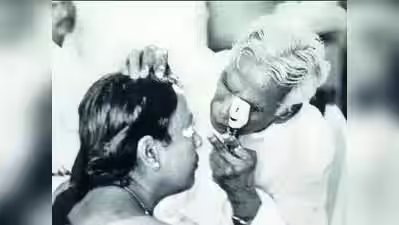
As a medical student in the 1940s, G Venkataswamy (popularly known as Dr V) had his sights set on obstetrics. But during the Second World War, he served as a physician, treating Japanese prisoners of war on the Singapore-Malaya front when rheumatoid arthritis forced him to return home. He was bed-ridden for 18 months. The disease left his fingers twisted, and eventually dashed his dream as he was now barred from pursuing obstetrics. Dr V turned to ophthalmology instead.Today, every 20th cataract operation in India bears the imprint of an institution that he began with 11 beds in a rented Madurai building five decades ago. Since 1976, Aravind Eye Care System has recorded nine crore outpatient visits and performed more than 1.1 crore surgeries, with nearly half its procedures provided free or at subsidised rates.“Right from his early days as a doctor, he wanted to help the poor,” says R D Ravindran, chairman of Aravind Hospitals. “At Madurai’s Government Erskine Hospital, now Government Rajaji Hospital, he encountered rural patients who had become blind because they could not afford treatment. Dr V created a nutrition rehabilitation centre, where children stayed for 21 days and received food and medical care. Their mothers learned to prepare vitamin-A-rich meals using local greens. Treatment did not end when they left the ward; each mother carried the knowledge back to her village.”From 1960, Dr V spent evenings and Sundays running village camps, often paying the accompanying staff from his pocket.Around 1971, when M Karunanidhi travelled to the US to have his eye condition treated, Dr V went with him, and showed the then chief minister Baltimore’s communiy screening. After they returned, outreach eye camps were adopted as a Tamil Nadu govt programme.“Dr V envisioned a McDonald’s type of eye care institution with standardised training and uniform service,” says Ravindran. After retiring in 1976, Dr V tried to build a free hospital. Despite his years of public service, a week of fundraising yielded less than `5,000.Rather than wait for donors, Dr V pooled his practice with those of G Natchiar, P Namperumalsamy, P Vijayalakshmi and M Srinivasan. In 1976, the five ophthalmologists opened an 11-bed private hospital called Aravind Eye Hospital in a building they rented in Madurai.Within two years, the hospital became a charitable trust and opened a treatment ward in a cashew grove. The facility was little more than a shed with a tin roof. Surgeons began at 4am, operating under focus lamps with simple magnification, and stopped before the heat became unbearable. The sutures were thick enough to be seen with the naked eye. “Aravind adopted sutured eye surgery early, drawing doctors to Madurai to learn the technique.”Expansion depended on the family. Relatives pledged jewellery, mortgaged a house. The effort produced a 70,000-square-foot outpatient block.Patients could choose the paying or free section, but the standard of clinical care remained the same. In effect, the income from one paying patient could support treatment for two others. Charges remained 40% below those at comparable hospitals. Patient volumes financed further expansion.Soon, Aravind had doctors specialised in retinal surgery, paediatric ophthalmology and corneal care. Patients began coming in from across the country for treatment. “Aravind recruited young women from villages who had completed Class XII and trained them in refraction, counselling, ward care and operating-theatre work. It created skilled employment for 10,900 women,” says G Natchiyar, director-emeritus of Aravind. “Over the years, Aravind has conducted 75,000 camps, including 3,450 last year. We have brought an estimated 1.5 crore people into eye screening across Tamil Nadu.”Today, Aravind performs about 4.8 lakh cataract surgeries a year. “On a busy Monday, more than 2,000 operations take place at various centres,” says Thusaliraj Ravilla, director-operations.“We document every stage of sterilisation and disinfection in 25 registers. We have an infection after one in 10,000 phacoemulsification procedures, compared with one in 2,500 in US data. Overall complication rate remains below 1%,” says Ravindran.“We also believe in sharing our methods,” says Ravindran. For instance, Aravind joined the Union govt to train medical-college professors, who returned home to teach other ophthalmologists. The same approach grew into the Lions Aravind Institute of Community Ophthalmology, or LAICO. “LAICO has worked with 394 hospitals in 29 countries, helping them collectively perform 10 lakh additional surgeries each year.”Aravind is now applying the same culture of shared learning to research. Doctors train in research methodology at the University of Michigan before registering for PhDs with Maastricht University, where five published papers replace the conventional thesis. New recruits must identify a research question, while teams help with methodology and execution. The approach contributed to 254 research publications in 2025.“Dr V believed in knowledge-sharing, and that’s what we continue to do today.”