








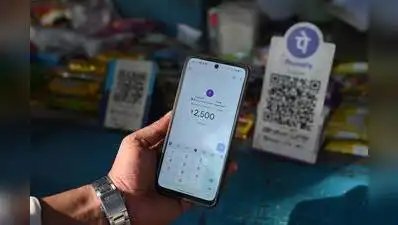
Gurgaon: Centre’s decision to introduce a 0.4% fee on specified UPI payments above Rs 2,000 has triggered concern among traders. Though it is supposed to be borne by the merchant, several businesses across Gurgaon that TOI spoke to Wednesday said the additional cost would eventually find its way to the consumer.The revised framework, which comes into effect from Oct 15, applies to specified person-to-merchant (P2M) UPI transactions above Rs 2,000. The merchant discount rate (MDR) will be capped at Rs 300 per transaction for payments of Rs 75,000 and above. UPI payments between individuals will remain free, while payments up to Rs 2,000 to merchants and eligible small merchants under the zero-MDR framework will also remain outside the levy.Traders said while the charge may technically be levied on merchants, businesses operating on tight margins could look to recover the additional expense through their pricing. For them, even a fraction of a percentage point matters, particularly where UPI accounts for a substantial share of daily collections.Amit Maheshwari, the owner of a jewellery store in Gurgaon’s Sadar Bazaar, says, “Our profit margin is around 3-4%. We will have to increase our making charges to absorb the additional cost. Ultimately, the impact will be felt by customers.”The concern is even more pronounced for businesses that make UPI payments both while getting money from customers and paying their own vendors. Pawan Yadav, a Gurgaon-based restaurant owner, says every day, his establishment receives around Rs 30,000-35,000 and purchases supplies worth around Rs 70,000 through UPI.The impact, he says, will thus be felt at multiple points. “It becomes a recurring expense. Businesses will have to recover these costs through their pricing,” Yadav said.In everyday retail, individual product margins can be modest but have to cover operating costs. A supermarket owner in Sushant Lok-2 says his store processes around Rs 60,000 to Rs 70,000 in UPI payments every day.“For products such as biscuits, instant noodles and cooking oil, our margins are around 5-7%. We were already paying 2% on card transactions and 4% for Amex cards,” he says.Calling MDR an “unnecessary expenditure”, he says merchants will have to reassess how they price products and manage payment costs.Roshan Lal, president of Sadar Bazaar Market Association, says merchants had thus far treated UPI payments like cash. “Now, they will have to factor in the 0.4% cost. Businesses cannot operate indefinitely by absorbing additional costs, so the pressure could eventually be reflected in what customers pay,” Lal says.Instead of putting an additional transaction-linked burden on businesses, govt could consider a one-time payment to maintain the digital payment infrastructure, he adds.Sumit Narang, president of a market association in the city who also owns a footwear store, says abandoning UPI is not an option since it has become an integral part of daily business. “We shifted to digital payments during Covid. We cannot do away with these payments, even if it means paying an additional 0.4%, because both customers and merchants have become accustomed to using it.”“Customers rarely carry cash anymore. Refusing digital payments would mean losing sales,” he adds.Hemant Garg, an electronics shop owner in Sector 14, Gurgaon, says around 80% of his store payments are through UPI. “Businesses like ours may be compelled to recover it through customers,” he says.Bipin Preet Singh, co-founder, MD & CEO, MobiKwik, however, calls MDR a positive step towards a more sustainable payments ecosystem. “UPI has scaled enormously over the last decade, but the cost of maintaining the underlying infrastructure, ensuring security and supporting this scale has also increased, putting pressure on banks and payment companies,” he says.He points out that the framework is targeted at higher-value merchant transactions. “Everyday payments and person-to-person transactions remain free, while small merchants are also protected from the impact. This means the change can create a revenue pool from larger-value merchant payments without altering the experience for the vast majority of consumers and small businesses,” he says.“At 0.4%, MDR for large merchants also remains significantly below the typical 1.6-1.8% cost associated with credit-card transactions. For merchants in categories such as travel, e-commerce and high-value retail, this creates a relatively modest cost while enabling the ecosystem to support continued investment in infrastructure and innovation,” Singh adds.Similar sentiments echoed in Delhi as well. Traders and shop owners in several markets, including Kalkaji, Kamla Nagar, Khan Market, Laxmi Nagar and Sadar Bazar, said the decision has created confusion over who will bear the additional cost. They said even if the charge is not directly recovered from customers, it would add to the cost of doing business and could squeeze already limited margins.Brijesh Goel, chairperson of Chamber of Trade and Industry, said the move could encourage a shift towards cash transactions.“In the past six years, we have with great difficulty brought even the smallest of shopkeepers and street vendors onto UPI. Today, 90% of payments in Sadar Bazar, Chandni Chowk, Lajpat Nagar, Chawri Bazar, Kamla Nagar, Karol Bagh and Gandhi Nagar are through UPI. If MDR is imposed, it will be a setback to the Digital India mission,” he says.New Delhi Traders Association general secretary Amit Gupta said traders had no objection to digital payments but are opposed to the additional cost.“UPI was introduced to make digital payments easier for both traders and customers. If traders are now asked to bear an additional charge on transactions above Rs 2,000, many of them will prefer cash payment,” he says.Petrol pump dealers, meanwhile, said they were waiting for clarity from the ministry of petroleum before deciding how to respond.