
Scientists have developed a floating farm that uses sunlight to turn seawater into fresh irrigation water, allowing vegetables to grow without relying on conventional freshwater supplies. The experimental system, known as a double-layered vertical solar sea farm, produced enough clean water to support broccoli, lettuce and Pak Choi in outdoor trials. All three crops recorded germination rates of more than 80%, and the plants continued to grow in the floating growing chambers. Tested at the University of South Australia, the design places a solar evaporation chamber beneath a soil-filled cultivation chamber, offering a potential way to produce crops on seawater and other salty surfaces.
How the floating farm turned seawater into fresh water
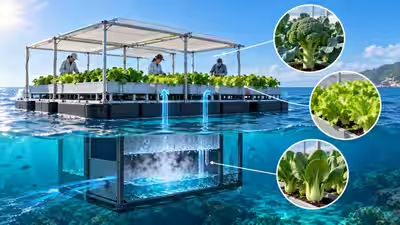
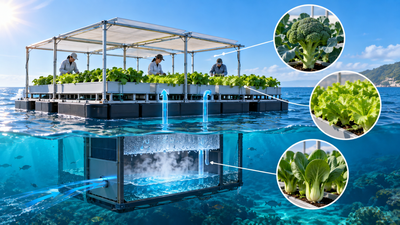
The DVSSF consists of two vertically arranged sections. The lower chamber produces clean water, using interfacial solar evaporation, while the upper chamber contains soil and supports plant growth. According to the study published in ScienceDirect, titled ‘An interfacial solar evaporation enabled autonomous double-layered vertical floating solar sea farm’, the lower section uses solar irradiation to evaporate seawater, while water-transfer belts carry the condensed water into the upper soil chamber. This means the crops are irrigated with desalinated water rather than seawater itself.Hydrophilic bamboo-paper belts were positioned through the cylindrical structure; they absorb condensed water from the lower evaporation chamber and move it to the growing chamber. A transparent cover enclosed the upper section, creating a greenhouse environment. The supporting structure used polystyrene foam, allowing the evaporation system to float on the water surface.
Solar material helped the floating farm produce fresh water
The researchers used a photothermal material made from reduced graphene oxide, tannic acid and a towel substrate to improve evaporation. The material was designed to absorb sunlight and convert it into heat at the evaporation surface. In the floating system, this solar-driven evaporation produced condensed water that could then be transported to the soil above.In the long-term outdoor tests, the successful version of the device kept the soil considerably wetter than versions missing either the water belts or photothermal evaporators. The soil in the successful DVSSF remained at around 20% water content throughout the 14-day experiment, while the other configurations fell to about 5% after 10 days and eventually dried and cracked.
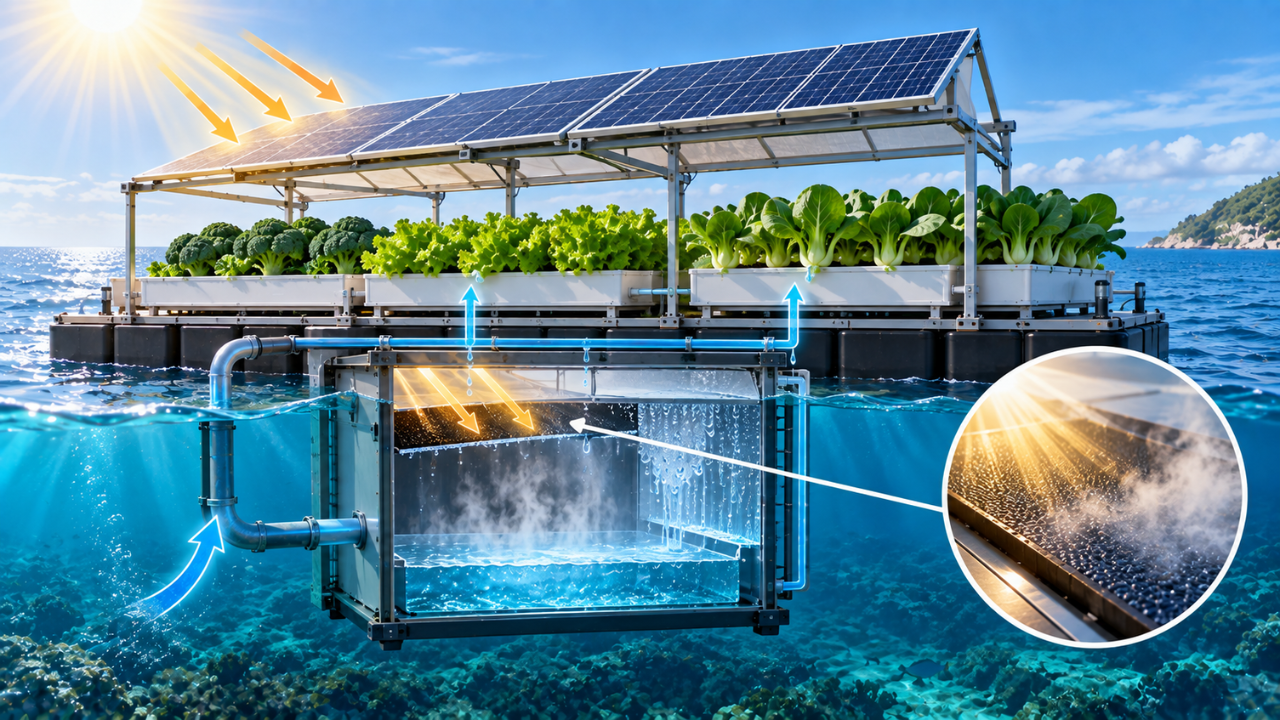
Image AI generated
Floating farm grew three vegetables with over 80% germination
Between 4 and 23 May 2022, researchers tested six DVSSF units in a 1-square-metre pool containing artificial seawater. Two units were prepared for each of the three crops: broccoli, lettuce and Pak Choi. The plants were then monitored outdoors as the floating systems produced water and maintained the growing environment.The researchers reported that all three vegetables grew well and that each had a germination rate above 80%. During the 20-day test, the plant chamber maintained humidity at roughly 75% when solar flux was at its maximum, while its internal temperature stayed below 40°C. The study therefore demonstrated that the same basic floating system could support successful germination and subsequent growth across three different vegetable crops.
Floating farms could expand agriculture onto the sea
The researchers see the technology as a possible route for marine agriculture because it uses the surface of water rather than conventional agricultural land. Their conclusions state that the system can float on seawater and salty water surfaces while producing clean water for crop growth. Because the lower evaporation chamber and upper cultivation chamber are integrated vertically, the design uses the available surface area efficiently.The researchers note several challenges, including the possibility that larger plants could block sunlight from reaching the evaporators. They also say rapidly changing environmental conditions could affect plant growth and suggest that future versions could use cheaper photothermal materials, improved spacing and intelligent controls. So, getting broccoli, lettuce and Pak Choi to germinate at rates above 80% shows that seawater-based floating agriculture can move beyond the idea stage and into practical experimental cultivation.