








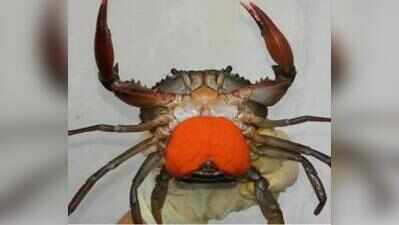
Panaji: Goa is considering a conservation framework to protect berried female mud crabs, including incentives for fishermen who release breeding crabs alive and the creation of designated crab reserves.The proposal was submitted to chief minister Pramod Sawant by ICAR-Central Coastal Agricultural Research Institute (ICAR-CCARI), which has also offered technical support. Sawant directed the institute to prepare standard operating procedures (SOPs) for conserving berried females. The draft has been prepared and submitted for scrutiny before being forwarded to the fisheries department.“Mud crab (scylla serrata and scylla olivacea) is among Goa’s highest-value estuarine resources and growing source of livelihood and income for coastal fishing community,” ICAR-CCARI director Parveen Kumar said.Under the proposed incentive scheme, fishermen who release berried crabs would be rewarded after their releases are verified through a mobile application recording the location and time. “I request Goans to avoid eating such crabs and release them into the sea instead. If we wish to attain self-sufficiency, we must conserve for the future,” Sawant said on social media.A mature berried female can release about one million to eight million eggs, though larval and juvenile survival can fall below 1%.ICAR-CCARI fisheries scientist Trivesh Mayekar said the scheme would allow fishermen to continue crab fishing while encouraging them to release breeding females.“Mature crabs breed in estuarine environments, after which berried females move towards nearshore and coastal waters to release their eggs or larvae. The young crabs subsequently return to estuarine and mangrove areas. It is during the movement of berried females from estuaries towards the coast that they can become vulnerable to fishing,” he said.The draft SOP proposes a minimum legal carapace width of 15cm. “If the female is at least 15cm, it will be mature enough and at least get one chance to spawn,” Mayekar said.The institute is also proposing a mud crab reserve in one or more estuarine areas where fishing would be restricted or prohibited to allow breeding. Mayekar identified the mangrove-rich area around Chorao Island, including the 200ha habitat around the Salim Ali Bird Sanctuary, as a possible site.The SOP will also spell out how fishermen can identify berried crabs, distinguish males from females, measure carapace width and handle breeding females after capture. Its recommendations draw on crab management practices in Australia, Vietnam and Indonesia.“The institute would act as the technical partner, while implementation of the proposed scheme would rest with the fisheries department,” Mayekar said.Fisheries director Shamila Monteiro said the proposal would be examined before any decision is taken. “We have been forwarded the letter from ICAR-CCARI regarding the proposal. It will be examined by the department before any decision is taken,” she said.