










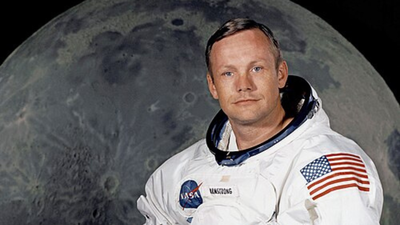
Human beings have always been drawn towards challenges that appear difficult, uncertain or even impossible. From exploring unfamiliar places to developing new technologies and solving scientific problems, progress often begins with the decision to attempt something that has never been done before. Astronaut Neil Armstrong, the first person to walk on the Moon, once offered a striking explanation for humanity’s drive to explore. Speaking during an Apollo mission press conference in 1969, Armstrong said, “I think we’re going to the moon because it’s in the nature of the human being to face challenges. We’re required to do these things just as salmon swim upstream.” His words suggest that exploration is not simply about achievement or competition. It reflects a deeper human instinct to confront challenges, push beyond existing boundaries and discover what lies beyond them.
Quote of the day by Neil Armstrong
“We’re required to do these things just as salmon swim upstream.”Armstrong’s comparison between human exploration and salmon swimming upstream captures a simple idea about persistence. Salmon instinctively undertake difficult journeys against strong currents because that struggle is part of their natural life cycle. Armstrong used the image to explain why humans repeatedly choose to confront challenges rather than remain within familiar boundaries. The statement came at a time when the Apollo programme represented one of the most ambitious technological undertakings in history. Sending humans to the Moon required scientists, engineers, astronauts and thousands of other workers to solve problems that had never previously been encountered on such a scale.The quote also presents difficulty as something that can encourage progress. Challenges can force people to develop new ideas, improve existing methods and reconsider what they believe is possible. Armstrong’s words therefore extend beyond space exploration. The same principle can apply to scientific research, engineering, medicine, environmental conservation and countless other areas where progress depends on people being willing to tackle difficult problems.
Why humans are drawn towards difficult challenges
People often choose challenging goals even when easier alternatives are available. Scientists investigate questions for which there may be no immediate answer, engineers attempt to develop technologies that have never existed and explorers travel into environments where conditions can be unpredictable. Such efforts can involve years of failure, experimentation and uncertainty before producing a breakthrough.Armstrong’s words suggest that this tendency is part of human nature. The desire to understand, explore and overcome obstacles has repeatedly pushed societies forward. The Moon landing itself was an extraordinary example. Reaching the lunar surface required advances in rocketry, computing, communications, navigation and materials science. Every stage presented problems that demanded new solutions. What appeared impossible at one point could become achievable after researchers found a way around each obstacle.
The meaning behind the salmon comparison
The reference to salmon is particularly powerful because swimming upstream is an inherently difficult journey. Salmon must expend considerable energy moving against the current, yet they continue because reaching their destination is essential to their life cycle. Armstrong used this natural example to describe humanity’s tendency to move towards challenges rather than simply follow the easiest path.The comparison does not suggest that every difficult task automatically has value. Instead, it highlights the persistence required when people believe a challenge is worth undertaking. Scientific and technological progress often depends on precisely that quality. Researchers may encounter failed experiments, unexpected results and years of setbacks, but continuing to investigate can eventually produce discoveries that change what is considered possible.
Armstrong’s words came at a historic moment
Armstrong made the remark in 1969, the year he became the first human to walk on the Moon during Apollo 11. The mission represented the culmination of years of work by NASA scientists, engineers and astronauts. Armstrong and fellow astronaut Buzz Aldrin landed the lunar module Eagle on the Moon on July 20, 1969, while Michael Collins remained in lunar orbit in the command module.The achievement was not simply a demonstration of individual courage. It depended on a vast scientific and engineering effort involving thousands of people. Armstrong’s explanation therefore provides an interesting perspective on the Apollo programme. He presented the journey to the Moon as part of a broader human impulse to confront challenges, rather than merely as a technological contest or a historical milestone.
The lesson for science and innovation
Armstrong’s words remain particularly relevant to scientific research and innovation. Many of the discoveries that shape modern life began with questions that did not have obvious answers. Researchers have to accept uncertainty and repeatedly test ideas, while inventors often have to overcome technical failures before arriving at a workable solution.The willingness to confront difficult problems can also create benefits that extend beyond the original goal. The technologies developed during major scientific programmes can lead to new applications, while research conducted for one purpose can eventually help solve completely different problems. In this sense, tackling ambitious challenges can expand knowledge even when the original objective does not produce the expected result.
The same idea applies to conservation
The principle behind Armstrong’s quote can also be applied to conservation. Protecting endangered species, restoring damaged ecosystems and reversing environmental degradation can appear overwhelming because many problems develop over decades and involve complex ecological and social factors. Yet conservation successes often begin when scientists and communities decide that a seemingly difficult problem is still worth confronting.Projects such as restoring endangered species, rebuilding forests or removing pollution require persistence over long periods. There may be setbacks before measurable improvements appear. Armstrong’s salmon analogy captures that willingness to continue moving towards a difficult objective despite resistance, uncertainty and obstacles.
A lesson about progress
The deeper message in Armstrong’s words is that progress rarely comes without resistance. Whether the challenge involves travelling to another world, developing a new scientific theory or restoring a damaged ecosystem, meaningful advances often require people to move beyond what is already familiar.His comparison with salmon also places human ambition within the natural world. Just as salmon continue their difficult journey upstream, Armstrong suggested that humans possess an instinct to confront challenges and move towards new frontiers. The destination may change from one generation to another, but the underlying impulse remains remarkably consistent.
The timeless lesson
Neil Armstrong’s words ultimately offer a lesson about curiosity, persistence and the human instinct to overcome challenges. The first journey to the Moon demonstrated what could happen when thousands of people committed themselves to solving a problem that had once seemed beyond reach. Armstrong’s explanation suggests that such efforts are not simply driven by the desire for fame or achievement. They can also emerge from a fundamental human need to explore, understand and test the boundaries of what is possible.More than five decades after Apollo 11, the challenge may no longer be putting the first person on the Moon, but the principle remains relevant. From exploring distant worlds to developing new technologies and protecting Earth’s threatened species, progress depends on people willing to move against the current. As Armstrong put it, “We’re required to do these things just as salmon swim upstream.”