








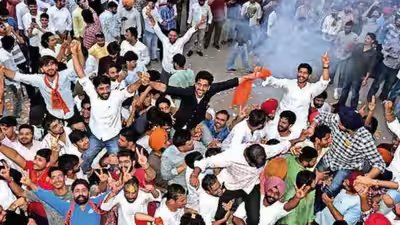
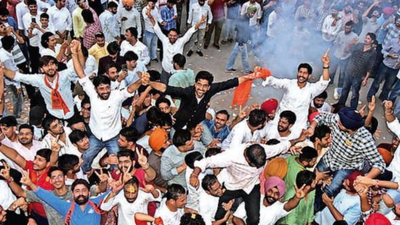
CHANDIGARH: The Akhil Bharatiya Vidyarthi Parishad’s (ABVP) second successive presidential victory at Panjab University was shaped by a combination of organisational unity, the return of last year’s breakaway faction to the campaign fold, influence of large voting departments and a divided field of rivals.ABVP’s Ankit secured 3,149 votes, defeating ASAP’s (Association of Students for Alternative Politics) Aadil Brar, who polled 2,637. NSUI’s (National Students’ Union of India) Gurman Singh Sidhu secured 2,263 votes, while SATH’s Darshpreet Singh got 1,387.ASAP entered the contest with considerable political firepower, with AAP MP Meet Hayer and MLA Amritpal Singh Sukhanand handling its campaign. NSUI, meanwhile, received public backing from senior Congress leaders, including Punjab Congress chief Amarinder Singh Raja Warring and Himachal Pradesh chief minister Sukhvinder Singh Sukhu.ABVP’s advantage was continuity. It had an organisation that had already won the presidency, a campaign team with experience and a candidate who was not new to campus politics.Among the four presidential candidates, Ankit was the only contender apart from Darshpreet to have been visible in PU politics for several years. Aadil Brar, though a relatively fresh presidential face, had served as UILS department representative and had an established campus network. Gurman was the freshest of the principal contenders — a disadvantage in an election where name recognition, personal networks and mobilisation can matter as much as party labels.The biggest change, however, came within ABVP itself. Last year, the breakaway ABVP Front had contested separately, with its candidate Naveen Kumar finishing second in the vice-president race with 2,828 votes. This time, several of those who had emerged as potential kingmakers were back in the ABVP campaign.Former PU ABVP campus president Rajat Puri, Political Science research scholar Vishal Malik, former UILS student Saksham Sharma and outgoing PUCSC president Gaurav Veer Sohal were actively involved. North Zone organising secretary Gaurav Attri, under whose organisational charge ABVP won its first PU presidency last year, was again involved.Significantly, ABVP did not need to increase its presidential vote. Ankit’s 3,149 votes were just one more than Sohal’s 3,148 last year. The total presidential votes, including NOTA, were also almost unchanged — 9,610 this year against 9,613 last year.What changed was the configuration around that vote. Last year’s eight-cornered contest allowed multiple candidates to occupy different pockets of the anti-ABVP vote. This year, the field was reduced to four, concentrating the contest but leaving the opposition split among ASAP, NSUI and SATH. ABVP was therefore able to retain roughly one-third of the presidential vote.