








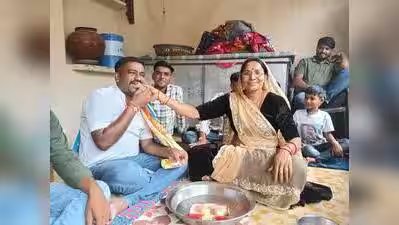
Jaipur: On Raksha Bandhan, 37-year-old Ramswaroop Gurjar looks at the sacred thread on his wrist and thinks of another bond — one that cannot be seen but keeps him alive every day.For years, Ramswaroop took painkillers to cope with a severe back problem. The medicines eased his pain but gradually damaged his kidneys. By the time he sought medical help, both his kidneys had failed.The diagnosis left Ramswaroop and his family shaken. He needed a kidney transplant to survive.In a family of six siblings, it was his eldest sister, Sugana Gurjar (60), who stepped forward. She did not hesitate. Her younger brother was critically ill, and she had a chance to save his life.On Aug 25, 2023, Ramswaroop received one of Sugana’s kidneys at a private hospital in Jaipur. Sugana does not describe what she did as a sacrifice. To her, it was simply what a sister had to do.“A sister always wants to see her brothers happy and healthy,” she said.The transplant gave Ramswaroop his life back. He recovered, returned to his village, and is now healthy enough to work as a farmer. Sugana, too, remains healthy after the donation.For Ramswaroop, Raksha Bandhan now carries a deeper meaning. It is no longer just about a sister tying a rakhi and praying for her brother’s well-being. In his case, his sister became the reason he survived.“If there is anyone to whom I owe my life, it is my sister,” Ramswaroop said. “I am a farmer and regularly go farming. I am leading a healthy life just because of my sister.”Their story echoes a striking pattern at the govt-run Sawai Man Singh Hospital, where the traditional Raksha Bandhan promise of a brother protecting his sister often unfolds in reverse.Since SMS Hospital began its kidney transplant programme, it has performed 882 transplants. In 31 cases, sisters donated kidneys to their brothers. Only once has a brother donated a kidney to his sister.For doctors, sibling donation offers a strong medical advantage. Dhananjai Agarwal, senior professor and unit head of nephrology at SMS Hospital, said siblings often make suitable donors because of Human Leukocyte Antigen (HLA) matching, which can lower the risk of rejection.“When a sibling donates a kidney to another sibling, there is a high chance of success,” Agarwal said. “In 25% of sibling donations, there is a 100% chance of HLA matching. In 50% of cases, there is a 50% chance of HLA matching.”But medical factors often meet social fears. Doctors said many men hesitate to donate, fearing that living with one kidney could make them weak or affect their work and future health. Women, meanwhile, often step forward quietly, viewing the decision as a family duty driven by love and urgency.This Raksha Bandhan, another brother and sister are waiting at SMS Hospital.Nitin Saini, 28, from a village about 35km from Nainital, has been living with kidney failure for nearly seven years. His 29-year-old sister, Sunita Saini has brought him to SMS Hospital and is preparing to donate a kidney.“My sister loves me a lot. She is ready to donate one of her kidneys,” Nitin said.Back home, the siblings run a small tea and coffee shop together. In Jaipur, she has become his caregiver, arranging appointments and helping manage their finances.“She is feeling the pain for me,” he said. “She is not married yet and still she is ready for this sacrifice.”