






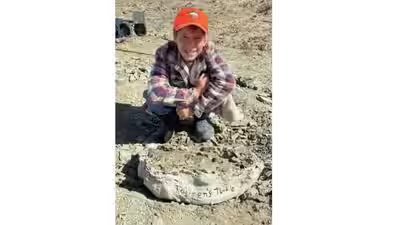
What began as a routine family rock-hounding trip in southwest Wyoming turned into a paleontological headline when 11-year-old Touren Pope noticed something unusual poking out of the ground. What he’d spotted was the fossilized shell of a softshell turtle that lived nearly 48 million years ago, preserved in the Bridger Formation of the Greater Green River Basin. After Touren and his grandparents reported the find to the Bureau of Land Management (BLM), experts confirmed its significance and arranged a careful excavation. In recognition of his discovery, Touren was given the rare honor of naming the fossil. Here’s the complete story, based on BLM and regional news coverage of the discovery:A keen eye on public landTouren Pope, a sixth-grader from Nevada, was visiting his grandparents in Wyoming in the fall of 2025 when the family set out to search for interesting rocks and minerals on BLM-managed land near Rock Springs. While scanning the ground, he noticed a dark, rounded object that didn’t look like an ordinary stone. Following the rules for vertebrate fossils on public land, the family left the specimen in place and contacted the BLM Rock Springs Field Office.BLM paleontology staff quickly recognised the potential importance of the find. J.P. Cavigelli, a paleontologist and museum specialist with the agency, said that within minutes they could tell it was a fairly complete turtle shell worth collecting. Because exposed fossils can deteriorate rapidly once they reach the surface, timing was critical. “If we don’t find them in time, they usually decompose quickly once they reach the surface,” BLM archaeologist Craig Thomas noted.Excavating “Little Timmy”In September 2025, a team from the Tate Geological Museum in Casper, working with BLM approval, returned to the site with Touren and his grandparents to fully excavate the fossil.The excavation revealed that only the turtle’s upper shell, or carapace, remained, but it was nearly complete and remarkably well preserved. The shell was carefully transported to the Tate Geological Museum, a BLM-approved repository, where it is being cleaned, stabilized, and prepared for research and possible public display.As a special thank-you, officials allowed Touren to give the fossil an official name. He chose “Little Timmy,” a moniker that has since appeared in news stories and museum communications about the specimen.By early 2026, Touren even came to the museum to help collections staff clean the fossil, further cementing his connection to the find. A window into a warm, river-filled past During the Eocene Epoch, roughly 48 million years ago, the Greater Green River Basin looked very different than the semi-arid landscape of today. It was much warmer then, with rivers and streams running throughout, supporting a bustling ecosystem of fish, crocodiles, turtles and other animals. Their remains were buried in sediments for millions of years, eventually turning into fossils within rock layers such as the Bridger Formation.Natural erosion later exposed Little Timmy’s shell at the surface, where it waited for someone with a sharp eye to notice. BLM officials say the turtle was likely a softshell species in the trionychid family, whose modern relatives still live in rivers and lakes today. Softshell turtles have flatter, more flexible shells than many other turtles, and their fossils offer clues about ancient aquatic environments and how these animals evolved over time.Why public-land rules matter for fossilsTouren’s discovery also highlights why rules around fossils on public land exist. Vertebrate fossils on BLM-managed areas are considered part of the nation’s scientific and cultural heritage, and removing them without authorization can destroy important context for researchers.By leaving the shell in place and notifying the BLM, Touren and his family ensured that professionals could document the site, collect the specimen properly, and preserve it in a museum where it can be studied and shared with the public.The BLM manages about 245 million acres of public land in the United States, much of it in the West, where erosion constantly exposes new fossils. Agency paleontologists rely on visitors to report potential finds so that significant specimens aren’t lost to weather, vandalism, or unregulated collecting. In that sense, Touren’s story is both a personal triumph and a model for how the public can help protect ancient history.From rock hound to fossil namesakeFor an 11-year-old, being credited with uncovering a 48-million-year-old turtle is extraordinary. For scientists, Little Timmy is a valuable data point in reconstructing the Eocene ecosystems of the Green River Basin.And for the museums, the specimen is a future exhibit that can inspire other young rock hounds to carefully examine the ground underfoot. Touren’s discovery reminds us that significant scientific contributions aren’t always made in university labs or with large field crews. Sometimes, they begin with a curious kid, a family outing, and the choice to do the right thing when something ancient and fragile emerges from the dirt.