






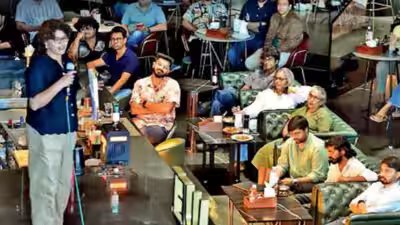
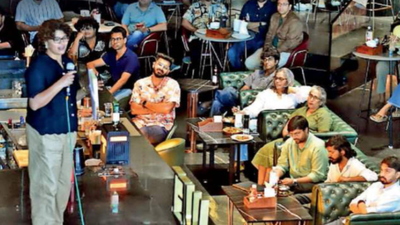
Hyderabad’s Pint of View is turning bars into lively classrooms, where curious crowds gather over drinks to explore science, poetry, politics, philosophy and more, finds Ajay Tomar.A Hyderabad resto-bar, the evening’s draw is not a DJ, match screening or new cocktail menu. It is string theory. On any night, it is Urdu poetry, bats, brain and memory, geopolitics, cinema, bird behaviour, psychology or philosophy.Across the city, people are choosing to spend two hours at a bar listening to researchers, diplomats, artists and specialists unpack complex ideas. They arrive in groups, order drinks, listen closely, ask questions and often stay back to argue, clarify or continue conversations with strangers.
Lecture sans distance
Unlike conventional lectures, POV speakers stand at bar counters, while audiences sit at tables. The mood is relaxed, but the discussions are serious.Shanti, a consultant working with Telangana govt, discovered POV through friends who had attended its Bengaluru events. “Instead of attending a highly academic talk with little opportunity for interaction, I prefer this relaxed environment, where we can question the speaker and one another,” she says.“The audience did not possess prior knowledge of the subjects. I had to explain without relying on the academic jargon used in the classroom.”— Shinod NK | Philosophy Prof, University of HyderabadFrom Bengaluru to HyderabadPOV was founded in Bengaluru by Harsh Snehanshu, Shruti Sah and Meghna Chaudhury. Inspired by the US-based Lectures on Tap format, it has expanded to 14 Indian cities, including Mumbai, Delhi, Gurgaon, Chennai, Goa, Hyderabad and Kolkata, as well as Amsterdam and London.Sah says the idea grew out of adults longing for intellectual freedom of classrooms, minus exams or career pressure. The founders share a format abroad and playbook with city curators, who choose local speakers and subjects. In Hyderabad, the chapter is curated by Trisha Bhugra, who says audiences have responded well to science, geopolitics, history and music.“While I am used to addressing strategic communities, universities and think tanks, speaking to a mixed public audience requires a different approach.”— Dr Raja Kartikheya | FORMER UNITED NATIONS DIPLOMAT
Breaking down complex ideas
For 30-year-old techie Gowtham Ravichandran, who has attended three sessions, the attraction is being introduced to subjects he would not normally seek out. “I enjoyed learning about a world I had never really considered before — the behaviour of nocturnal creatures,” he says. A geopolitics session had a similar effect. “I liked that it made us think beyond daily news and consider how foreign policy decisions are shaped,” he says.Anirudh, 31, attended sessions on psychology and geopolitics.“Working professionals may not have the time for lengthy programmes, but they can set aside two hours to listen to a specialist explain a complex idea,” he says. “Everyday experiences, such as forgetting a name, or recalling an old event triggered by a smell or song, could be understood through neuroscience,” he says.“People rarely get the opportunity to discuss what they have learned with others in person,” says team member Barasiya Ghosh.
Collective learning, rethinking watering holes
Tanaya Pashankar, a vegan guest lecturer at Mindspace Social. Venues such as Over The Moon Brew Company, Windmills Madhapur, Red Rhino and Luft Bar & Kitchen later signed up for the series.National Institute of Fashion Technology, says the relaxed setting reduces distance between speaker and audience. “It allows participants to ask questions they might otherwise hesitate to raise.”Anita Reddy, an entrepreneur, says the experience sits between a fun evening and a lecture. “The inclusive crowd, ranging from people in their 20s to their 50s, was what drew me,” she says.The venues, too, had to adjust. When Trisha first approached bars and restaurants, some were hesitant. “We had to explain that the events were not intended to promote alcohol consumption,” she says.The Hyderabad chapter began at Mindspace Social. Venues such as Over The Moon Brew Company, Windmills Madhapur, Red Rhino and Luft Bar & Kitchen later signed up for the series.Pallabi Pande, a consultant, attended a cinema and politics session titled “Phata Poster, Nikla Hero”. “I am not a major follower of South Indian cinema, but the argument that no art form is entirely apolitical caught my attention,” she says.Getting academics to speak in bars was not easy. “We had to clarify that the venue was not intended to replace classrooms,” says Trisha. “Instead, it offered academics access to people they might not encounter through conventional institutional channels.”POV Hyderabad’s first session, led by Anusha Shankar of the Tata Institute of Fundamental Research, focused on wildlife science and drew about 60 people. Some sessions now attract 200 to 250 participants. A lecture on string theory by Shubho Roy had to be held twice, with around 200 attendees at each session. The chapter now has about 4,000 followers on WhatsApp and 20,000 on Instagram and attendance is for a fee.For speakers, the challenge is to make specialised and accessible without reducing it to trivia. The format revives curiosity often lost in formal education.“Exams, competition and professional specialisation often narrow people’s interests, leaving them with little time to learn about subjects outside their own fields,” says Saroj Jha, a former United Nations diplomat who served in Afghanistan, Iraq, Iran and other parts of West Asia.Growing thirst and audienceHyderabad’s first session, led by Anusha Shankar of the Tata Institute of Fundamental Research, focused on wildlife science and drew about 60 people. Some sessions now attract 200 to 250 participants. A lecture on string theory by Chubo Roy had to be held twice, with around 200 attendees at each session. The chapter now has about 4,000 followers on WhatsApp and 20,000 on Instagram and attendance is for a fee.For speakers, the challenge is to make specialised research accessible without reducing it to trivial. The format revives curiosity often lost in formal education.“Exams, competition and professional specialisation often narrow people’s interests, leaving them with little time to learn about subjects outside their own fields,” says Raja Karthikeya, who is a former United Nations diplomat who served in Afghanistan, Iraq, Iran and other parts of West Asia.“We do not want POV to be associated with one discipline. A participant may arrive for a talk on geopolitics and return for one on ads, philosophy or music.”— Parth Sarathi | TEAM MEMBER