






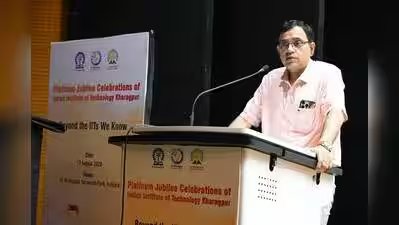
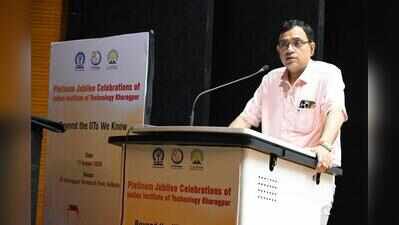
Kolkata: An IIT can no longer measure its greatness solely by the achievements confined within its own campus walls. Instead, an IIT must become a mentor of mentors—strengthening NITs, IIITs, universities, colleges, schools, MSMEs, hospitals, local govts and entrepreneurial ecosystems, said IIT Kharagpur director Suman Chakraborty on the future of the IITs at the institute’s research park in Rajarhat.IIT Kharagpur, the first IIT in the country, established on Aug 18, 1951, is celebrating 75 years of its legacy with a week-long programme that started from Aug 15.According to Chakraborty, for decades IITs have been “extraordinary talent creators” but now they have to become “transformation creators”. At the heart of this reinvention is a decisive shift from operating as “islands of excellence” to building expansive “networks of excellence”.Chakraborty shared, “The future IIT cannot measure its greatness only by what happens within its own walls. An IIT must become a mentor of mentors—strengthening NITs, IIITs, universities, colleges, schools, MSMEs, hospitals, local governments and entrepreneurial ecosystems…Knowledge created at an IIT must travel; capability created at an IIT must multiply.”He further stressed that the measure of an IIT should not merely be “Who recruited our students?” It should increasingly be “What did our students create?” According to him, the future of an IIT graduate will not be defined by their starting salaries, but by their capacity to create new technologies, companies, institutions and entirely new sectors. “To facilitate this, campuses will be transformed into giant living laboratories, enabling students to move seamlessly from the classroom and laboratory to prototyping, field validation, startups, and eventual scale,” he added.Highlighting the action plan, he called for the building of shared national research infrastructure to avoid the costly duplication of facilities. “Let us create interoperable innovation corridors connecting IITs with universities, hospitals, industry and government. Let faculty and students move more easily across institutional boundaries,” said Chakraborty, adding that alumni must become co-creators and research parks should transform into translation parks where academia, industry, startups, investors and policymakers physically collide.Recognising that tomorrow’s pressing problems will refuse to respect today’s departmental boundaries, he emphasises that challenges like cancer and climate change require integrated solutions spanning medicine, engineering, earth science, policy and technology. “Our next institutional architecture must be built around problems, not merely departments. At IIT Kharagpur, our advantage is precisely this breadth. Engineering must meet medicine; AI must meet agriculture; science must meet entrepreneurship; technology must meet humanities, law, management and public policy,” he shared.Chakraborty feels, “The first 75 years proved that India could build institutions equal to the world’s best. The next 25 years must prove something bigger: that institutions built in India can help build a better world. The IIT of the future must be globally competitive precisely because it solves problems at Indian scale.”