










Hyderabad: The average cost of hospitalisation in Telangana has now further gone up to ₹55,000, up from ₹52,743 reported in the Household Consumption Expenditure Survey (HCES) released in April this year.The latest figures from the ‘Parliamentary Standing Committee report on health and family welfare’ placed Telangana at the top of the states with the highest hospitalisation expenditure in the country.
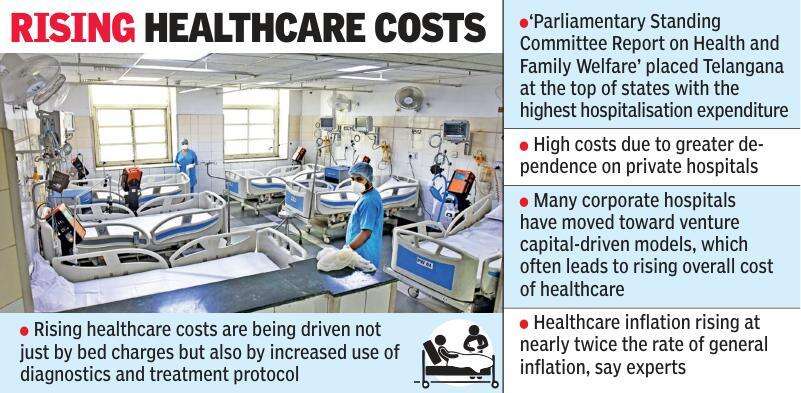
Next to Telangana stands Tamil Nadu with an average of around ₹52,000, while Karnataka and Kerala’s costs are in the ₹40,000 to ₹45,000 range followed by West Bengal and Maharashtra, where total spending was recorded at or above ₹40,000.On the contrary, states such as Odisha, Meghalaya and Mizoram fared better with costs ranging between ₹20,000 and ₹25,000 – less than half of Telangana’s cost.According to the report, the high hospitalisation costs in Telangana were majorly related to greater dependence on private hospitals. It also highlighted that gaps in govt healthcare infrastructure, overcrowding and shortages of doctors and specialists are pushing patients towards private facilities, where treatment costs are significantly higher. Moreover, health experts pointed out that many corporate hospitals have increasingly moved toward venture capital-driven models, which often leads to rising overall cost of healthcare.The Committee has also recognised concerns over the growing dependence on private equity, particularly in capital-intensive tertiary care, and its potential to put upward pressure on treatment costs. This needs serious policy attention, without treating long-term private investment itself as the problem.A “missing middle” in healthcareSenior public health expert Dr Ranga Reddy Burri said Telangana is a classic example of the “missing middle” in healthcare, with limited options between govt hospitals and expensive corporate hospitals.“We have witnessed healthcare inflation rising at nearly twice the rate of general inflation, fuelled by increasing hospitalisation expenses and insurance premiums. It is driven in part by a race among private equity-backed hospital chains pursuing aggressive acquisitions at high rates. Over-reliance on high-cost private hospitals and limited govt capacity are pushing patients towards expensive treatment even for moderate conditions,” he added.Experts also highlighted that rising healthcare costs are being driven not just by bed charges but also by increased use of diagnostics and treatment protocols. “Overuse of MRI, CT scans and endoscopy has been flagged as a factor driving up costs in some corporate hospitals. Advanced diagnostics do not always lead to better outcomes,” said Dr Burri.Pushing families into debtThe Telangana Socio-Economic Survey 2026 shows that nearly 10% of household loans in the state are taken for health-related expenses, mostly due to medical emergencies.Dr Kiran Madhala, general secretary of the Telangana Teaching Doctors Association, said the figure reflects the growing financial burden of healthcare. “When 10% of loans are for healthcare, it signals a systemic failure, not just an affordability problem. Hyderabad attracts patients from across the world because treatment is affordable for them, but the same healthcare is becoming unaffordable for its own residents,” he added.Gaps in public healthcareExperts also linked the issue to gaps in public healthcare, including specialist availability, diagnostics, medicines and hospital beds. “Commercialisation of healthcare can sometimes influence treatment decisions. Lack of strict regulation of procedure and package costs is also increasing the financial burden on patients,” said Dr Karthik Nagula, president, Telangana Healthcare Reforms Doctors Association.Experts also emphasised that the state govt should increase recruitment and strengthen district hospitals, ICU and emergency services, medicines, diagnostics and referral systems. “Poor price transparency, unchecked billing, dependence on corporate hospitals and weak public healthcare infrastructure are adding to the burden on patients,” said Dr Ashish Ankam, president, Telangana State Residents Doctors Association (TSRDA).Health budget hikeThe ongoing construction of upcoming three TIMS in Hyderabad and expansion of the NIMS could reduce dependence on private hospitals, but both the parliamentary report and experts believe this needs higher public health spending such as increasing govt bed capacity, recruiting specialists, ensuring medicines and diagnostics, strengthening urban healthcare and tighter regulation of private hospital billing.The report also called for AI-enabled financial surveillance to identify billing anomalies, audit excessive out-of-pocket expenditure (OOPE) and help standardise tertiary-care pricing.“There is also need for swift and equitable settlement of health insurance claims, particularly for marginalised groups. The state govt spending on health, currently around 4.2% of the state budget, should be increased to at least 8% for sustainable and equitable healthcare,” said Dr Madhala.