





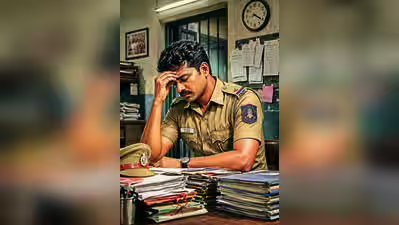
Ram.Sundaram@timesofindia.comOn July 31, just a fortnight after his child was born, a 27-year-old constable in Chennai took his own life. He is the sixth Tamil Nadu police officer to die by suicide in 40 days —the 18th this year. In April, say officers, a govt-funded programme for the wellbeing of state police was put on hold. The project was meant to identify personnel showing suicidal ideation, severe stress and other signs of mental distress before they reached a point of crisis.“We don’t know why he chose to end his life,” says a police officer about the constable. “It may have been his addiction to online gaming that triggered it. He lost a lot of money.” The officer adds that the other five personnel who died in the past 40 days were also below the rank of inspector.A 2019 study conducted by the Tamil Nadu police found that 64% of its personnel were in distress, while another 4% had suicidal ideation. In Nov that year, the state home department launched the wellbeing programme in partnership with National Institute of Mental Health and Neuro Sciences (Nimhans) and Madurai-based M S Chellamuthu Trust, focused on lower-rank personnel and used statewide awareness/counselling sessions to identify those requiring support. In Nov 2021, the intervention was expanded under the name ‘Magizhchi’ to provide medical care to those identified during the sessions. Around 4,500 personnel were treated for personal problems, work stress, addiction, substance dependence and social issues over four years.The programme was initially financed through Tamil Nadu police welfare. In Dec 2025, it was shifted to the modernisation of police forces division, which is partly funded by Union govt. A govt order sanctioned `2.5 crore for Magizhchi and the wellbeing programme for 2025-2026. More than `62 lakh from that allocation, however, remains unpaid. No govt order has been issued for 2026-2027, leaving counselling, screening and medical follow-up in limbo.Director general of police Mahesh Kumar Agarwal did not respond to TOI’s queries on the funding delay and the future of the programme. Home Secretary K Manivasan said he would “check and get back”.Tamil Nadu had earlier emerged as a model for police wellbeing initiatives. Union govt had advised the state to present the programme on the integrated govt online training platform (iGOT) so other states could study and replicate it.“The pressure usually begins outside the workplace but worsens when officers lack time or support to deal with it,” says M Divya, a psychologist who has counselled police personnel. “Personal and family problems are the leading causes of distress. Financial difficulties come next, followed by addiction and work-related pressure.”Mental health support is critical for police personnel, who may be called to duty at any hour and are expected to remain available throughout the day, says retired DGP R Nataraj. “Personnel will have personal problems. Senior officers need to ensure the welfare of those in their department. If it is done, they will deliver well. Ultimately, that is what matters most.”The wellness programme funding freeze is only one part of a larger welfare deficit. Police personnel continue to face long working hours, uncertain breaks and grievance systems that many fear using. “The state issued an order in 2021 granting one day a week off to lower-rank officers, but it is still not being followed consistently,” says advocate G Sakthi Rao, who represented head constable Senthil Kumar in a case over the issue. In 2025, Madras high court kept the matter under continuing mandamus, allowing subsequent violations to be raised through contempt proceedings. “Police personnel were reluctant to approach the court as they feared backlash, adverse remarks or a black mark from their superiors that could make daily work more difficult,” says Rao.Human rights activist and social worker K Raja says distress within the police force cannot be treated as an “internal departmental issue”. “Police personnel are the face of the govt and often the first point of contact for people in trouble. When officers are struggling, their ability to listen to complainants and respond with empathy is affected. At present, we can see many police personnel becoming angry and struggling to cope with stress. It is high time the govt revived these programmes,” he says.