











Hyderabad: The National Green Tribunal (NGT) has taken note of the Telangana govt’s submission that it is moving from reactive firefighting to a coordinated forest fire risk-management system, more than two years after the tribunal took suo motu cognisance of a TOI report on forest fires in Eturnagaram Wildlife Sanctuary and Amrabad Tiger Reserve.In a counter-affidavit filed before the tribunal, the Revenue (Disaster Management) Department said it had submitted a ₹27 crore proposal under the National Disaster Mitigation Fund (NDMF). The plan covers satellite-based fire alerts, firefighting equipment, including leaf blowers and fire-resistant suits, and the integration of local community task forces with the State Disaster Response Force (SDRF).The affidavit was filed by Harichandana Dasari, secretary to the govt holding full additional charge of the Revenue (Disaster Management) Department, on July 20, 2026.NGT acted on TOI fire reportThe tribunal initiated the case after taking note of the March 26, 2024, Times of India report, “Forest fires singe Eturnagaram & Amrabad wildlife sanctuaries”. The report highlighted fires in the Tadvai region of Eturnagaram Wildlife Sanctuary and the Amrabad Tiger Reserve.
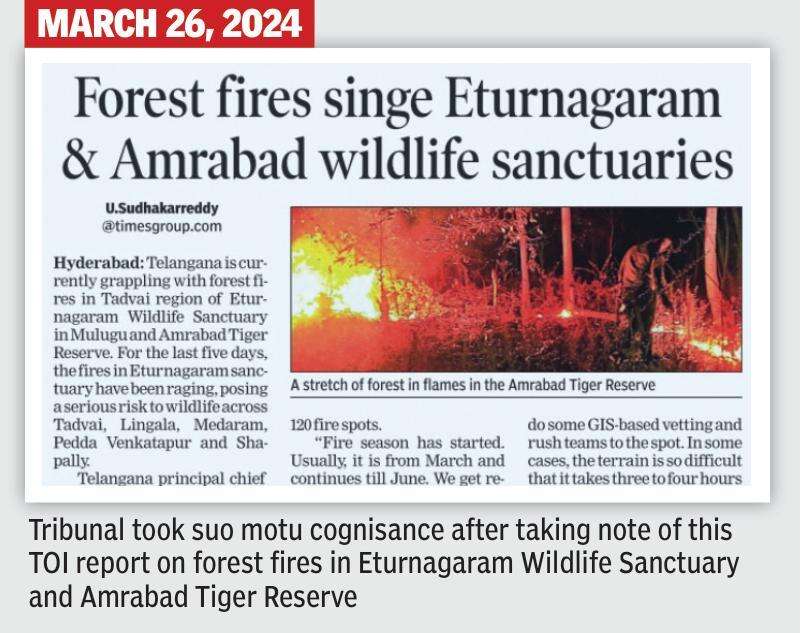
Then Principal Chief Conservator of Forests RM Dobriyal had said that Telangana recorded an average of 100 to 120 fire spots a day during the forest fire season, which generally runs from March to June. He said most fires were caused by human activity.The causes cited included cooking by local fishermen, burning of the forest floor by tribal communities collecting mahua flowers, and fires set by bidi leaf contractors to promote fresh leaf growth. The Forest Department had also stressed the need to bring forest fire control within the disaster-management framework so that additional resources and institutional assistance could be accessed.Responding to the proceedings initiated by the tribunal, the Disaster Management Department said it was developing what it described as a “Forest Fire Risk Management Ecosystem”, with coordination among govt agencies, field personnel and local communities.The department also informed the tribunal that multi-stakeholder mock drills were conducted in high-vulnerability districts in May 2026. The exercises tested field-level response, communication channels and coordination during forest fire incidents.809 alerts, 680 hectares burnt in MuluguIn a separate report dated July 22, 2026, filed before the NGT in response to the TOI news report, the Mulugu district collector provided details of the fire incidents and preventive measures in Eturnagaram Wildlife Sanctuary.According to the report, 809 fire alerts were received during the 2024 fire season between January and April. An estimated 680.86 hectares were affected.The collector said the incidents were ground fires that burnt dried leaf litter. The report maintained that standing trees and wildlife were not damaged.The district administration attributed the fires largely to human interference, including the collection of mahua flowers and bidi leaves. Awareness campaigns were conducted among villagers, including advice to spread old clothes beneath mahua trees to collect falling flowers instead of burning dried leaves and vegetation on the ground.Meetings were also held with bidi leaf contractors, who were warned that legal action would be taken if they resorted to setting fires.The collector said the administration had maintained 48.7 kilometres of fire lines to restrict the spread of fires. Since 2019, it had also constructed 59 check dams and 109 percolation tanks to improve soil moisture and reduce fire vulnerability in and around the sanctuary.