









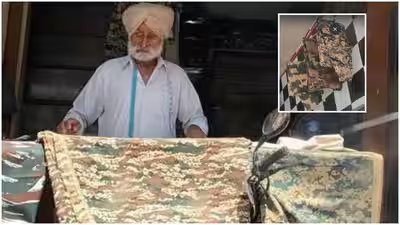
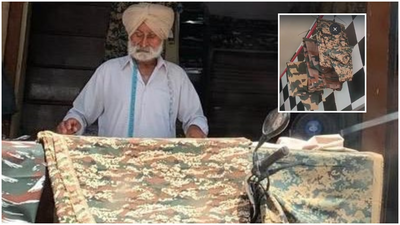
NEW DELHI: Busting a big racket on counterfeit military uniforms, a joint operation by Indian Army’s intelligence units and Rajasthan police has led to the seizure of nearly 1,000 metres of unauthorised army-pattern combat cloth from shops across the state’s Sriganganagar district.Acting on a lead, intelligence personnel of the Indian Army carried out a discrete investigation in the city, which pointed to a local firm, as a key link in the supply chain allegedly distributing counterfeit army-pattern combat cloth to shops in Sriganganagar town as well as Lalgarh Jattan, Suratgarh and other nearby markets, the Indian Army said.An interim investigation report was shared with Rajasthan police in mid-July, leading to a coordinated operation on July 30 in which security personnel and police searched multiple shops across the district. The raids yielded approximately 1,000 metres of unauthorised, new-pattern counterfeit combat cloth, exposing a wider network allegedly supplying counterfeit military uniforms to vendors in the region, the Army said.The action followed a seizure of similar counterfeit combat cloth in Bareilly in June this year, which was traced back to a manufacturing source in Sriganganagar.
Share your thoughts in the comments
Be respectful · TOI community guidelines
Radical elements and terrorists had in the past exploited open-market military fatigues to infiltrate high-security zones or stage attacks such as in Pathankot and J&K.In India, unauthorised sale, production or storage of official military-pattern camouflage cloth is heavily restricted and banned by local civil administrations in many sensitive regions. Section 168 of the Bharatiya Nyaya Sanhita (BNS), 2023 punishes any civilian who unlawfully wears military uniforms or carries tokens of the Indian armed forces with the intent to trick others into believing they are a soldier, sailor or airman.Furthermore, the Indian Army holds exclusive Intellectual Property Rights (IPR) over its digital camouflage pattern design, making commercial reproduction by open-market vendors illegal.