








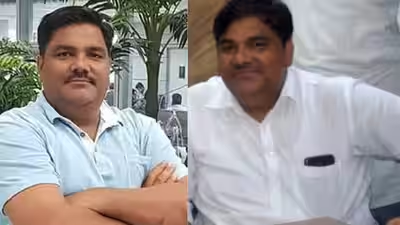
NEW DELHI: Before the Delhi court sentenced former AAP councillor Tahir Hussain and four others to life imprisonment in the murder of Intelligence Bureau (IB) officer Ankit Sharma, the prosecution had pressed for the death penalty, arguing that the killing was so brutal and premeditated that it fell within the “rarest of rare” category.Citing the nature of Sharma’s injuries, the manner in which his body was disposed of and Hussain’s position as a public representative, prosecutors urged the court to award capital punishment.Special Public Prosecutor Madhukar Pandey told the court that Sharma’s murder was marked by “exceptional brutality” and deserved the harshest punishment under law.
’51 injuries, seven fatal wounds’
Explaining why the prosecution sought the death sentence, Pandey said Sharma had sustained 51 injuries, of which seven were fatal.“Our argument is based on the brutal way the victim was killed. There were 51 injuries on his body, seven of which were fatal… The most shocking aspect is that a heavy sharp-edged weapon was used for one of the injuries,” he said.According to the prosecution, Sharma, who was unarmed, was surrounded by a violent mob and subjected to a sustained assault.“Here was an unarmed man surrounded by a mob. He was attacked and subjected to a continuous assault… Absolutely no mercy was shown to him,” Pandey said.
‘Body dumped in drain, cloth tied around neck’
The prosecution also highlighted the manner in which Sharma’s body was allegedly disposed of after the murder.“Instead of taking him to a hospital, they simply dumped his body into a drain,” Pandey said.He further told the court that evidence and witness testimonies suggested Sharma’s clothes had been torn off.“The evidence and witness testimonies reveal that the victim was wearing nothing but his underwear. All his other clothes had been torn off… A cloth was tied around his neck to drag him to the other side of the drain, from where Ankit Sharma was thrown down,” he said.Pandey argued that the murder was not a spontaneous act of mob violence but a carefully executed crime.“I argued that the entire act was meticulously planned,” he said.On this basis, the prosecution urged the court to classify the case as one of the “rarest of rare” and impose the death penalty.“I requested the court to treat this as a rarest of the rare case and impose the death sentence,” Pandey said.Rejecting the defence’s plea for leniency, the prosecution argued that Hussain’s position as an elected public representative made the offence even more serious.“I countered that his role as a public servant and councillor actually heightened his responsibility compared to that of an ordinary citizen,” Pandey said.“Those pleading for leniency before the court ought to have shown some mercy themselves.”The prosecution’s arguments came during the sentencing hearing after Tahir Hussain and four others were convicted on July 13 for the murder of Ankit Sharma during the February 2020 northeast Delhi riots.The trial court, however, rejected the prosecution’s plea for capital punishment and sentenced Hussain and the four co-convicts to life imprisonment.Sharma, an Intelligence Bureau officer, was killed during the communal violence in northeast Delhi in February 2020.His body was later recovered from a drain, and the case went on to become one of the most high-profile prosecutions arising out of the riots.(With ANI inputs)