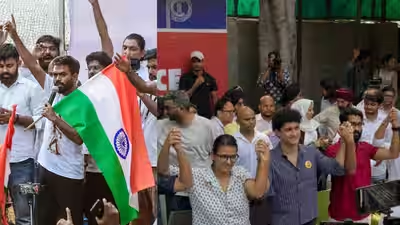










New Delhi: Every protest held at Jantar Mantar is videographed by authorities, not just the ongoing CJP-led one, Centre told Delhi High Court Friday as it termed “ironic” a PIL claiming a right to privacy in a public area.“When there is a legitimate state interest, proportionate state action can take place,” Solicitor General Tushar Mehta said in response to a PIL by former JNU Students’ Union president Aishe Ghosh against Centre and Delhi Police, alleging “continuous, indiscriminate and intrusive surveillance” at the Jantar Mantar protest.The SG said seeking privacy in a public place is an “oxymoron”, pointing out at any time “50 or more” influencers and other people post on social media videos shot on mobile phones and take interviews at the site, and CJP itself has asked the protesters to “videograph everything”.Mehta said it is “ironic that they are claiming privacy in a public place”, adding that videography at protest sites is a routine law-and-order measure conducted in accordance with standing orders issued pursuant to Supreme Court directions.Senior advocate Nandita Rao, for the petitioner, however, stressed that state action cannot be equated with the conduct of private individuals. “Citizens are different. State is on a much higher pedestal,” Rao said, alleging the protest site was under CCTV surveillance and private conversations of protesters were also being recorded, “which can be later used by the police”.She urged a bench of Chief Justice D K Upadhyaya and Justice Tejas Karia to direct Centre to respond, but the bench said it will examine the matter on July 27. “There are issues and issues. We need to make up our mind first. We will have it on Monday,” the court said.The plea asserts that the right to privacy is not surrendered in public spaces and raises concerns over the presence of police personnel in civil dress for video recording and the alleged use of facial recognition technology by police to identify protesters.Referring to Delhi Police’s standard operating procedure, Rao contended that a protocol was required to regulate the video recording of protesters, including how long such content would be stored by the authorities.The PIL, filed through lawyer Subhash Chandran K R, has sought a declaration that “continuous and intrusive mass surveillance” of peaceful protesters is constitutionally impermissible, disproportionate and cannot be justified under the guise of maintaining public order or national security.“The surveillance is indiscriminate in nature, extending to every individual present at the protest site, irrespective of any suspicion of unlawful conduct and encompassing not merely the public acts of protest, but also the ordinary incidents of daily life, including eating, resting, seeking medical assistance and other personal activities,” the plea stated.