









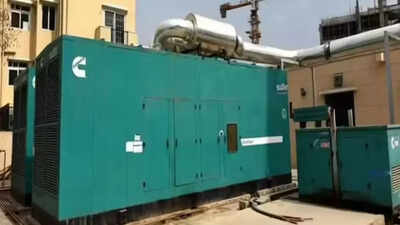
MUMBAI: Diesel generator (DG) sets, relied upon by millions of homes, housing societies, hospitals, offices, industries and construction sites during power outages, could be contributing far more to urban air pollution and public health risks than previously recognised, according to a new study by researchers from Shiv Nadar University.The study, published in the peer-reviewed journal Emission Control Science and Technology, found that stationary diesel generators emit large quantities of ultrafine and submicron particles laden with toxic carbon compounds that can penetrate deep into the lungs, potentially increasing the risk of respiratory illnesses, cardiovascular diseases and even cancer.The findings assume significance for cities such as Mumbai, where diesel generators are widely used in high-rise residential complexes, commercial buildings, hospitals, malls, hotels and infrastructure projects as backup power sources.Led by Prof Sailesh Narayan Behera of the School of Engineering, Shiv Nadar University, the researchers said stationary diesel generators have remained a “hidden” source of pollution despite extensive attention on vehicle emissions, industries and construction dust.“While diesel generators help bridge gaps in electricity supply, their hidden health costs cannot be ignored. Understanding and addressing these emissions is essential if India is to balance energy reliability with public health and environmental sustainability,” Behera said.The research analysed emissions from a stationary diesel engine under six operating loads and characterised 24 trace elements and eight carbon fractions across 10 particle sizes ranging from 56 nanometres to 18 micrometres.It also assessed how these particles deposit within different regions of the human respiratory system using internationally accepted lung deposition models.One of the key findings was that emissions increased sharply as engine load rose.While organic carbon dominated at lower loads, elemental carbon, commonly known as soot or black carbon—became the dominant pollutant when generators operated under heavier demand.Most emissions were concentrated in the submicron size range, making them particularly hazardous because such particles can bypass the body’s natural defence mechanisms.The study found ultrafine particles were capable of reaching the deepest parts of the lungs, while increased engine loads significantly raised the respiratory deposition of particulate matter.Researchers warned that prolonged exposure could trigger pulmonary inflammation, reduce lung function and contribute to chronic respiratory and cardiovascular diseases.The particles may also enter the bloodstream and affect other organs, including the cardiovascular and nervous systems.According to the researchers, the groups most vulnerable to exposure include children, senior citizens, asthma and heart patients, generator operators, maintenance workers, construction labourers and residents living close to generator installations.The paper also points out that previous source apportionment studies by the Central Pollution Control Board had identified diesel power generators as a significant contributor to particulate pollution in major Indian cities, including Mumbai, Delhi, Chennai, Bengaluru, Pune and Kanpur.The researchers have urged policymakers to bring stationary diesel generators more firmly within air quality management frameworks by strengthening emission monitoring, tightening regulatory oversight and encouraging cleaner backup power technologies such as battery energy storage, gas-based systems and renewable-powered alternatives.For urban residents, the study suggests that while backup generators ensure uninterrupted electricity during outages, they may also expose nearby populations to invisible air pollutants with long-term health consequences.It recommends minimising unnecessary generator use, ensuring proper maintenance and locating DG sets away from occupied spaces wherever possible, while accelerating the transition to cleaner backup power systems.