








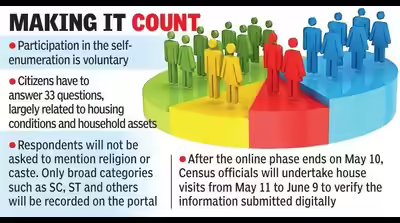
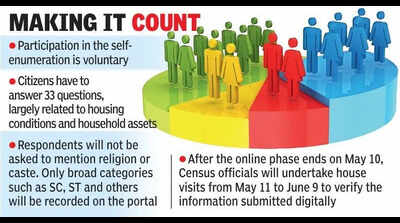
Hyderabad: For the first time in Telangana, residents will be able to count themselves before the Census knocks on their doors. The new system also brings an interesting definition of family and household. Under the rules, even unrelated individuals can be counted as one household if they live together and share a common kitchen. If they stay under the same roof but do not share meals, they will be treated as separate households.In a major shift from the traditional door-to-door exercise, the state is set to launch self-enumeration from April 26, allowing households to submit details online through a mobile application or the Census portal. The process gives flexibility in choosing the head of household (HoH). The HoH need not be the eldest member or only the male head of the family. Any person recognised by the household as responsible for managing it can take that role. 3 categories of householdsOfficials have identified three categories of households for the exercise: Normal household – members who share meals from a common kitchen. Institutional household – unrelated persons living in institutions such as hostels or care homes who share meals. Houseless Household – persons living in open spaces or temporary shelters. Their details will be collected during the population enumeration phase. Several states and Union Territories, including the Andaman and Nicobar Islands, Goa, Karnataka, Lakshadweep, Mizoram, Odisha, Sikkim and designated areas of Delhi such as New Delhi municipal council and Cantonment board, have already begun self-enumeration this month. During this phase, respondents will not be asked to mention caste or religion. Only broad categories such as SC, ST and others will be recorded. The self-enumeration window will remain open till May 10. Self-enumeration is being positioned as a citizen-friendly digital option that allows any eligible respondent in a household to fill in details online from home or office through a secure web portal. Officials describe it as a significant move towards a modern, efficient and inclusive data collection system. House visits from May 11After the online phase ends, Census officials will undertake house visits from May 11 to June 9 to verify the information submitted digitally. Participation in self-enumeration is voluntary. Citizens will answer 33 questions, largely related to housing conditions and household assets rather than personal demographic details. Socio-economic data, including caste and religion, will be collected during the population enumeration phase scheduled for 2027.