








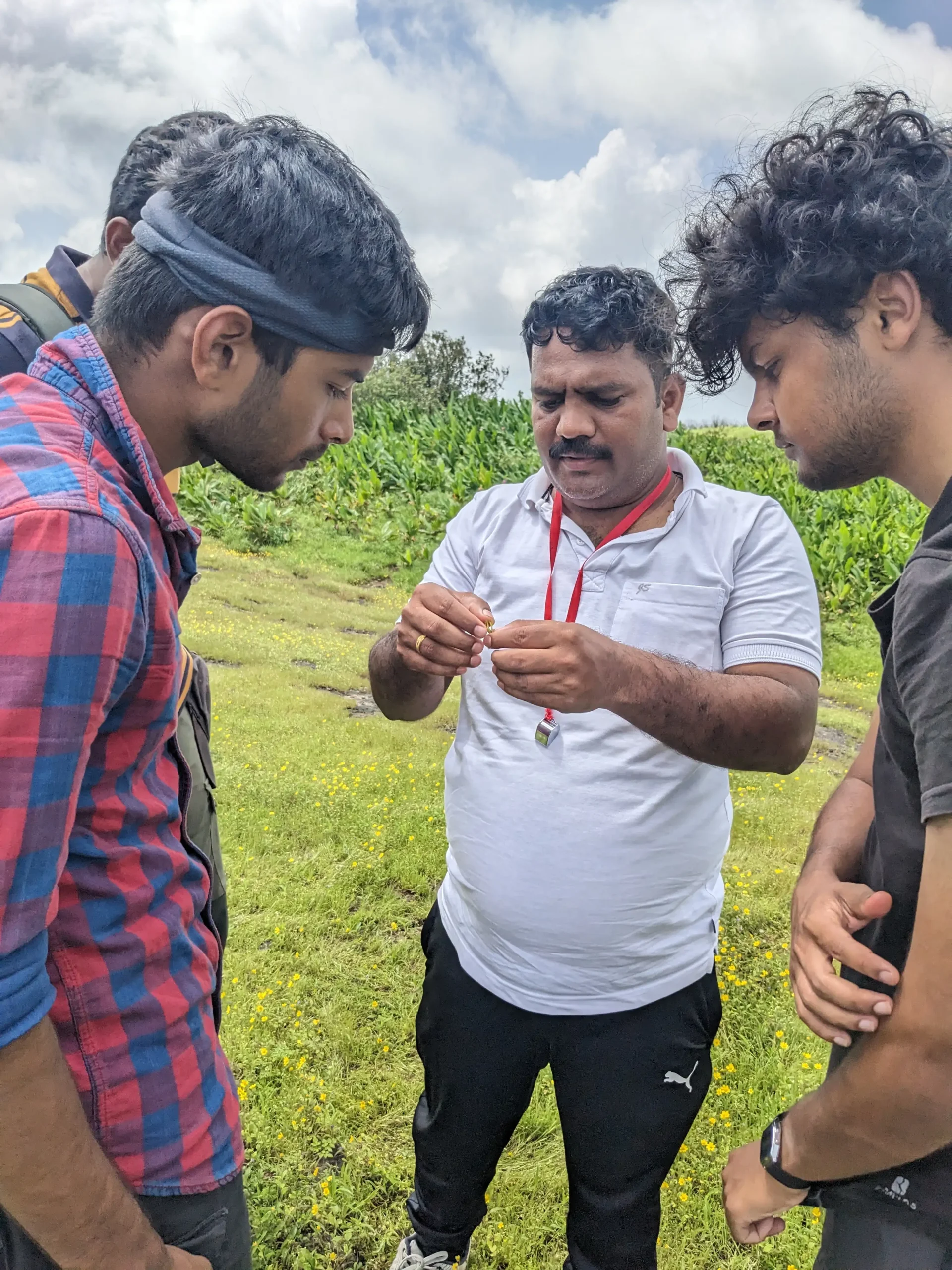
Pune: A routine survey of Pune’s grasslands led to the botanical discovery of a new flower species, which was long mistaken for another.Nestled among the grass on Sus Hill, the delicate annual herb resembled Canscora alata, a slender flowering plant found across Asia and Africa with small white flowers and distinctive winged stems. But to ecologist Ashish Nerlekar, something about it did not add up.The instinct eventually led to the identification of Canscora agni, a previously undocumented species described in the Nordic Journal of Botany, in June by Nerlekar, a faculty at the Indian Institute of Science Education and Research (IISER) Pune’s Department of Biology, and Sharad Suresh Kambale, a faculty at KTHM College, Nashik.“While I was doing fieldwork for my long term project last year, I came across a weird-looking Canscora. It didn’t fit perfectly with the known C. alata and C. perfoliata. I sent the images to Sharad, who is an expert on this. We did a detailed study of the descriptions of C. alata, including the original descriptions and then came to the conclusion that this is indeed a new species,” said Nerleker.To the untrained eye, the two plants appear almost identical. Canscora agni grows to barely 10 cm in height, while C. alata can reach 60 cm. It has fewer and much smaller leaves, broader four-winged sepals instead of eight narrow ones, hairy floral bracts, differently shaped winged flower stalks and a shorter ovary. These consistent structural differences, observed across specimens and verified against existing botanical records, are what qualify Canscora agni as a species distinct from C. alata rather than merely a variation of it.The name Canscora agni is equally significant. Agni, meaning fire in several Indian languages including Marathi, was chosen because the species thrives in landscapes shaped by frequent fires.“Fires, both natural and anthropogenic, keep woody species at bay, leading to more open canopies and greater diversity in the herbaceous layer where many of these endemic species are found,” Nerlekar explained. “When fires are stopped for a long time, many sun-loving endemic herbaceous plants cannot tolerate the shade and simply die. This is a good reminder that sunlight is a limiting resource for plants in general, and savanna plants in particular,” he said.It challenges the common belief that fire is invariably harmful. In the mesic savannas of western Maharashtra, periodic surface fires prevent shrubs and trees from taking over, allowing grasses and smaller flowering plants to flourish. Without these fires, woody vegetation spreads, the canopy closes, leaf litter accumulates and many grassland specialists gradually disappear.“Describing a species, should be looked at as an opportunity to tell something more about its ecology,” Nerlekar said. “Precisely because of this, ours is one of the first studies in India to have quantitative data on the drivers of plant diversity at the study site alongside the taxonomic work. We hope this paper stimulates some conversation about fires in India,”he said.The researchers found that the richest plant diversity occurred in frequently burnt grasslands with tall grasses and relatively little leaf litter, strengthening the argument that fire is an ecological process rather than simply a disturbance to be eliminated.The discovery also underscores how much remains unknown about India’s ancient grasslands. “A recent paper we published found that much of the endemic biodiversity in Indian savannas has only been described in the last couple of decades, with an exponential rise in new species descriptions from the region,” Nerlekar said.For decades, forests have dominated conservation conversations, while grasslands and savannas were frequently dismissed as degraded forests or wastelands. Botanists now believe these open ecosystems harbour a remarkable diversity of specialised plants that remain poorly documented, partly because many resemble already known species and partly because grasslands have historically received far less scientific attention.For Nerlekar, the discovery also calls for a broader rethinking of how India’s savannas are managed. “Humans have been burning India’s savannas for thousands of years and there should be no shame in acknowledging the fact that people can shape nature in complex ways, and even in ways that benefit endemic species,” he said.