








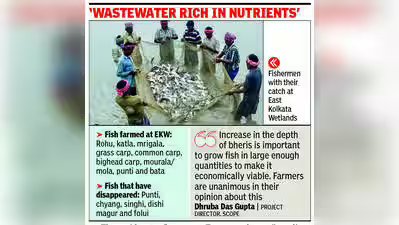
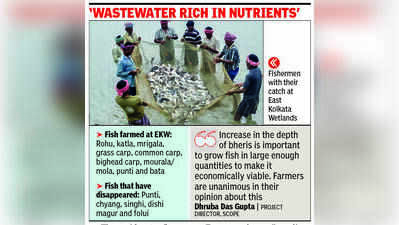
Kolkata: Restoring sewage flow into the East Kolkata Wetlands is essential to revive small indigenous fish and strengthen wetland fish farmers’ livelihoods, farmers and experts said at a workshop organised by CGIAR-IWMI and implemented by the Society for Creative Opportunities and Participatory Ecosystems (SCOPE).The programme brought together researchers, fisheries advisors and local stakeholders to discuss ways to reintroduce species that have declined or disappeared from the wetland system over the past four to five decades.Farmers said the wetlands once supported small fish such as punti, chyang, singhi, dishi magur and folui, which were important for nutrition, biodiversity and household income. At present, the bheris mostly grow rohu, catla, mrigala, grass carp, common carp, bighead carp, mourala/mola, punti and bata. Farmers are also battling the banned invasive African magur, which has entered the ecosystem.They said water flow, water quality and siltation are critical for fish growth in the wetlands’ non-saline water bodies. Reduced and irregular sewage inflow, changing water quality and siltation have affected fish habitats.“With the exception of tilapia, we find that other fish do not breed in EKW because the wastewater environment is not the choice for breeding. Farmers buy fingerlings from suppliers and grow them in these ponds,” said fish farmer Sujit Mondal.Experts said certain indigenous fish varieties must be bred in controlled environments such as fish tanks before being introduced as fingerlings in the bheris. “The wastewater is perfect for growth of fish as it is rich in nutrients and acts as perfect fish feed,” said CIFRI senior scientist and Fisheries Resource Assessment and Informatics division head Srikanta Samanta, whose two-year studies found that wastewater in EKW is safe as fish feed.Increasing the depth of bheris is also important for viable fish production. “Increase in the depth of bheris is important to grow fish in large enough quantities to make it economically viable. Farmers are unanimous in their opinion about this,” said SCOPE project director Dhruba Das Gupta.Deeper water bodies would improve water retention, reduce stress during dry periods and provide better habitats for fingerlings and mature fish.Fish farmer Niranjan Mondal called for cleaner water pockets within bheris for small fish growth. He recommended shorshe khol, or mustard oil cake, and badam khol, or nut oil cake, as locally available feed options.Speakers said small fish are commercially valuable and rich in micronutrients, and coordinated action is needed to restore ecological balance while protecting EKW livelihoods.