








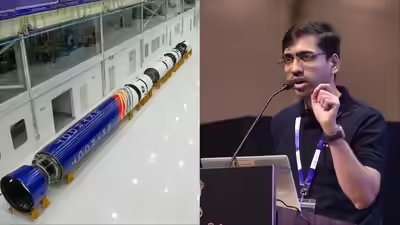
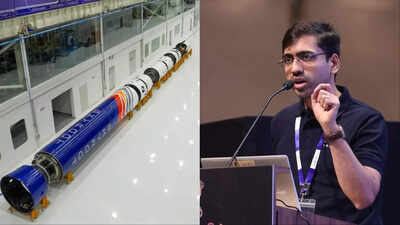
India marked a milestone in its private space sector, as Hyderabad-based Skyroot Aerospace successfully launched Vikram-1, the country’s first privately built orbital rocket, from the Satish Dhawan Space Centre in Sriharikota. The mission, named Mission Aagaman, placed technology demonstration payloads from Indian and international customers into Low Earth Orbit, along with symbolic payloads including a handwritten “Vande Mataram” postcard from Prime Minister Narendra Modi, postcards from scientists and astronauts, and a micro-art installation.Ahead of the launch, Skyroot Aerospace CEO and co-founder Pawan Kumar Chandana described the mission as a landmark moment for India’s space ecosystem. “Today, we are here at the Spaceport of India, Sriharikota, where we are going to launch India’s first private orbital rocket. The first time in India that a private company has developed an orbital rocket and taken it to the launch site and is going to take off soon. It’s a proud moment for India,” Chandana said.He added, “Very few companies in the world have actually launched a rocket to orbit, and very few companies in the world are operating regular orbital rockets. This is a very unique capability which the world needs. As an Indian company, we are very proud that we are going to launch our first test flight of Vikram-1 soon.”Behind the achievement is a journey that began with academic struggles and eventually led Chandana from the classrooms of Hyderabad to India’s space programme and, later, to building one of the country’s leading private space companies.
From struggling in maths to IIT Kharagpur
Born in Hyderabad in 1991, Chandana’s school years did not hint at a future in rocket science. He once scored just 51 marks in mathematics, a subject that later became central to his engineering career.Encouraged by his father, he enrolled in coaching for the IIT entrance examination. The experience gradually transformed his approach to mathematics, helping him qualify for IIT Kharagpur on his first attempt.In 2007, Chandana joined IIT Kharagpur, where he pursued a dual B.Tech-M.Tech programme in Mechanical Engineering. While many of his peers opted for corporate careers, Chandana chose to pursue his interest in space technology.
Building rockets at ISRO
After graduating, Chandana joined the Indian Space Research Organisation (ISRO) in 2012. During nearly six years at the Vikram Sarabhai Space Centre in Thiruvananthapuram, he worked on the GSLV Mk-III programme, the S-200 solid rocket booster and later served as deputy project manager for the Small Satellite Launch Vehicle.His contributions earned him an internal innovation award in 2016. However, Chandana also began exploring the possibility of establishing a private space company, despite the absence of a policy framework for private participation at the time.
Taking the entrepreneurial leap
In 2018, Chandana resigned from ISRO and co-founded Skyroot Aerospace with fellow former ISRO engineer Naga Bharath Daka.Starting a space technology company presented financial challenges. Chandana reached out to entrepreneur Mukesh Bansal through LinkedIn, seeking support. Bansal invested US$1.5 million in the venture. During the pandemic, additional backing came from the founders of Greenko, enabling Skyroot to continue its development plans.The company achieved another milestone in 2020 by successfully testing the Raman-1 engine, becoming the first private Indian company to test a rocket engine.
Skyroot’s rise in India’s private space sector
Following the opening of India’s space sector to private companies in 2021, Skyroot signed an agreement with ISRO and raised US$51 million in what was then India’s largest deep-tech funding round.In November 2022, the company launched Vikram-S, India’s first privately developed suborbital rocket under Mission Prarambh.The successful launch of Vikram-1 now places Skyroot among a small group of private companies worldwide capable of developing and launching orbital rockets.
Company valuation and future
Skyroot Aerospace was valued at around US$1.1 billion after raising US$60 million in a funding round in May 2026. While Chandana has not publicly disclosed his personal net worth, his wealth is closely linked to the company’s valuation.With Vikram-1 successfully reaching orbit, Chandana’s journey reflects the rapid growth of India’s private space sector—from a student who struggled with mathematics to leading one of the country’s most significant commercial space missions.