









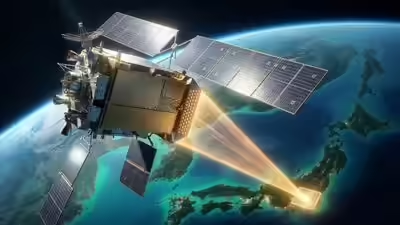
Space-Based Solar Power (SBSP), a technology Japan is currently pioneering to ensure a sustainable future, has the ability to provide a world where solar energy never fades, even when the sun sets or clouds gather. At the heart of this journey is the OHISAMA project, named after a lovely Japanese term for ‘the sun’ that conveys warmth and gratitude.Commissioned by the Ministry of Economy, Trade and Industry (METI) Japan, this mission plans to launch a small satellite into orbit by 2026. Unlike land-based solar farms, this revolving power station will capture high-intensity sunlight in space and beam it back to Earth using precise microwave technology. If successful, OHISAMA will provide the first real-world proof that we can harvest clean, ‘always-on’ energy from space.
What is the OHISAMA mission
The OHISAMA project is a government-led initiative coordinated by the Japan Aerospace Exploration Agency (JAXA) and Japan Space Systems. The mission will use a small satellite weighing approximately 180 kilograms which is roughly the size of a household washing machine. Scheduled for launch in 2026, the satellite will be placed into a low earth orbit at the height of about 400 to 450 kilometres from the ground.Once in position, the satellite will unfold a solar panel measuring approximately two square metres to capture sunlight. While the power output is roughly one kilowatt, which is just enough to run a small appliance, the mission’s true purpose is to serve as a high-tech ‘proof of concept.’ It aims to demonstrate that solar energy can be collected in the harsh environment of space, and beam down accurately to a specific target on our planet in the form of microwaves.
How can we beam down solar energy from satellite
The process begins with the satellite’s solar panels, which convert sunlight into direct current (DC) electricity. This electricity is then converted into a 5.8 GHz microwave beam. These microwaves are a reliable power supply with the ability to pass through Earth’s atmosphere with very little loss of energy, unlike the laser beams which can be blocked by heavy rain or thick clouds.On the ground, a specialized receiving station in Suwa, Nagano Prefecture (Japan) will be waiting to catch the beam. This station has 13 antenna arrays spread across 600 square metres, designed to capture the microwave signal and convert it back into usable electricity. These ground receivers are often called ‘rectennas’ (rectifying antennas).
What are the main goals of this OHISAMA space project
The researchers have planned five critical experiments for the OHISAMA mission:
- Evaluating how well a modular ‘phased array’ antenna (a flat panel that can turn its beam electronically) functions in space.
- Confirming that the satellite can hit its target on the ground from hundreds of kilometres away with incredible accuracy.
- Demonstrating that the transmitted energy can actually power devices, such as an LED light, on the ground.
- Testing if power can be transferred between two flying objects in orbit, which could help space stations or moon bases.
- Observing how high-power microwaves interact with the ‘ionosphere’ (a layer of our atmosphere filled with charged particles), to ensure it does not disrupt GPS or radio communications.
Why is Japan leading the way in space-solar technology
Japan’s interest in space-solar is driven by necessity. According to the ‘Ministry of Economy, Trade and Industry (METI),’ Japan, the country currently imports more than 90 percent of its energy, leaving it vulnerable to global price increase and supply chains. Space-based solar power offers a unique solution because it bypasses the three main challenges of Earth-based solar which entails the ‘nighttime, weather, and a lack of available land for giant solar farms.’ A satellite can receive sunlight nearly 24 hours a day, providing a steady base of electricity that could eventually replace fossil fuel-based power plants.
What are the challenges facing the OHISAMA project
The primary challenge is ‘precision.’ The satellite will be travelling at over 17,000 miles per hour, yet it must keep its microwave beam locked onto the ground receiver with an error margin of less than 0.001 degrees. Even a tiny disturbance could cause the beam to miss the receiving station entirely.Another hurdle is the ‘long power chain.’ Energy-loss is present at every step from when sunlight becomes electricity, when electricity becomes microwaves, and when those microwaves travel through space to reach Earth. Current targets for these early tests estimate an efficiency of around 10 to 15 percent. Furthermore, researchers must ensure that the heat generated by the electronics does not damage the satellite, as there is no air in space to cool the components down.
What does the future of solar energy look like after 2026
If the 2026 OHISAMA mission is successful, it will pave the way for much larger projects. The Japanese plan includes moving to megawatt-scale demonstrations in the early 2030s. The ultimate goal is to launch a massive, one-gigawatt power station into geostationary orbit by 2050, equivalent to the output of a large nuclear reactor.At a distance of 36,000 kms away, the satellite would appear stationary over a fixed point on Earth, allowing it to provide a constant stream of clean energy to the electric grid. This technology could also support the Artemis programme, providing power to the remote bases located in the dark craters of the Moon’s south pole.