









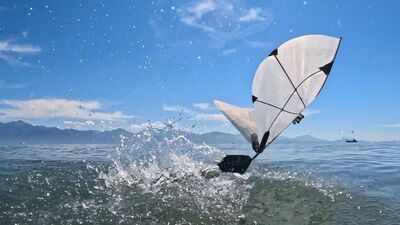
Nature has given us amphibians in various forms, from frogs to other multi-environment creatures, yet few things transcend the different domains of Earth as remarkably as the diving birds that inspired the MIT and EPFL researchers. For so long, scientists have long dreamt of a machine that can fly through the clouds like a bird, swim into the depths of the ocean, and then back into the sky, seamlessly. Water diving birds like the ‘Atlantic puffin’ glide effortlessly between the air and the ocean, despite the two environments having different physical properties. Now a team of engineers from MIT and Swiss Federal Institute of technology (EPFL) has finally created a lightweight, winged robot that possesses this biological ability, showing that the same wings can navigate through both worlds. This breakthrough is a huge step in how we explore and monitor our vast, mysterious oceans.
What makes this MIT robot so special
To understand the significance of this achievement, we need to look at the science first. Water is about 1,000 times denser than air. Usually, a wing designed to lift the robot in the air would be too fragile or inefficient to push through the heavy resistance of water. Most previous attempts at ‘amphibious’ drones involved two different systems of propellers and wings working together, which made them heavy and complicated.The MIT-led team, headed by Raphael Zufferey, took a different approach by looking at the puffin. Their creation, known as the ‘flapping-wing aerial-aquatic vehicle (FAAV),’ weighs less than 300 grams, about the same as a large apple. It doesn’t use propellers or extra engines; instead, it relies entirely on a single pair of wings to both fly and swim. By studying nearly 100 species of diving birds, the researchers built a machine that handles the shift between air and water smoothly.
How does this amphibian robot handle the air and water at once
The secret lies in wing flexibility. Rather than using mechanical joints to fold its wings underwater like a real bird, the robot uses ‘flexible membrane wings’ reinforced with carbon fibre struts. When the robot is in the air, these wings are firm enough to lift the robot for flight. However, the moment it hits the water, the wings passively bend by up to 90 degrees. This quick shift reduces the wing surface area, decreasing the load on the motor, allowing it to stroke through the water without breaking.Another clever design choice was the ‘open-body frame.’ Instead of trying to build a heavy, air-tight shell to protect the electronics, the engineers allowed water to flood the entire system. Every individual component like the motor, the battery, and the sensors is waterproofed separately with silicone. This allows the robot to stay exactly where it is in the water without sinking or floating to the surface. This saves an enormous amount of battery power earlier required to avoid floating.
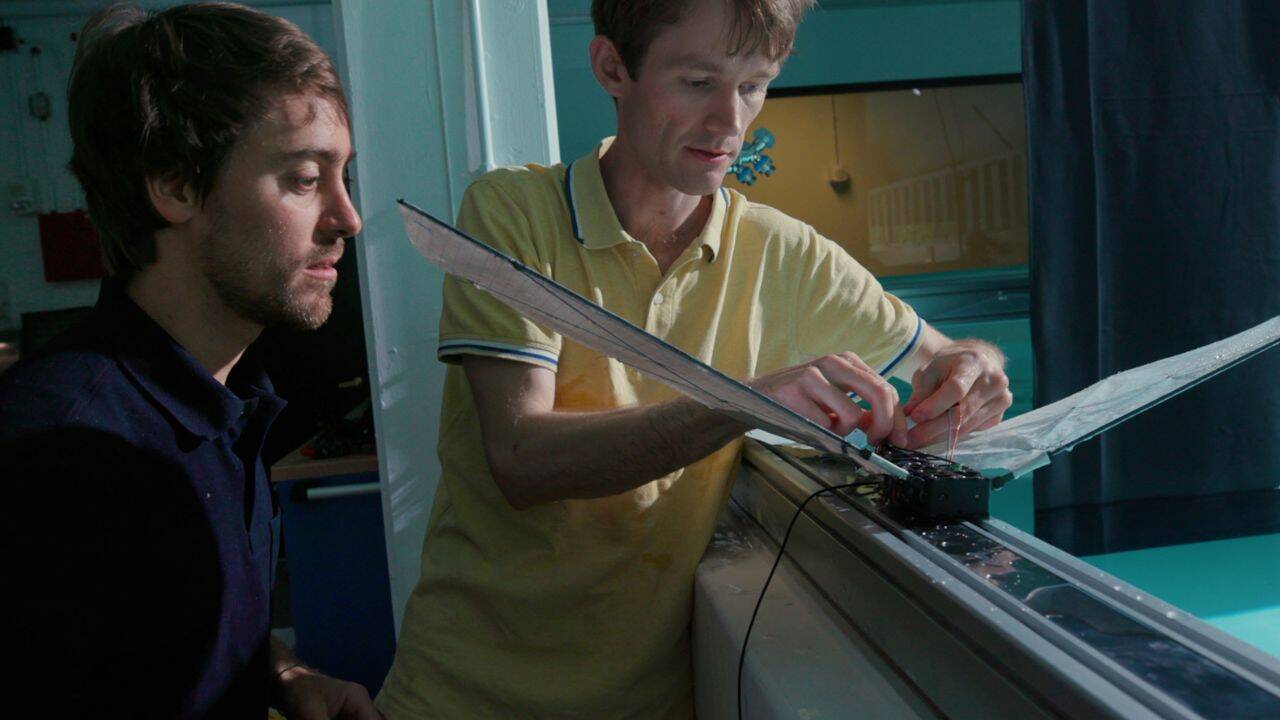
Image Credit: John Freidah
Can this robot really take off without a run-up
One of the most impressive parts of the MIT study was the ‘water exit.’ If you have ever watched a duck or a puffin take off from a lake, you have seen them paddle furiously with their feet to get enough speed to lift off. The researchers initially thought their robot would need something similar.However, they discovered a mechanical shortcut. By programming the robot to pitch upward at a steep 70-degree angle, the wings alone could generate enough thrust to pull it out of the water and into the air in less than a second. To achieve this, the robot has to flap about 10 times a second to break free of the water’s surface tension. It’s a power consuming move, but it eliminates the need for heavy robotic legs, keeping the machine lightweight.
What has this robot taught us about our nature
This project is a tool for biological discovery. Scientists have long debated why diving birds reduce their wing area underwater. Is it to save energy, or to gain speed? By testing different wing sizes and flexibilities on their robot, the team found that smaller wings actually don’t save energy. Instead, they significantly increase underwater speed and navigation. This suggests that when a puffin tucks its wings, it isn’t trying to be efficient, it’s trying to be fast. The robot also confirmed that larger diving birds likely must use their feet to take off because the wing-only launch demands energy. Only the smallest, lightest birds, like the kingfisher, can afford to skip the foot based takeoff, which matches exactly what the researchers observed in their bird-scale robot.
What does this mean for the future of ocean research
The potential applications for the FAAV are vast. Traditional ocean research often requires large, expensive ships or slow-moving underwater robots. Zufferey’s vision is to provide a much cheaper and faster alternative. Imagine a group of these ‘aerial-aquatic robots’ that could fly at the speed of six metres per second, to a specific area of interest, such as a remote coral reef, or a pod of whales. They could dive in, take water samples or temperature readings, and then fly back to base to deliver the data. On a single charge, the current prototype can fly for about four miles or swim for a little over a mile. Best of all, the researchers have made their designs open-source. With roughly £230 ($300) in materials and a 3D printer, coastal communities and marine biologists could build their own fleet of aerial-aquatic robots.By copying the amazing abilities of diving birds, we are finally creating technology that can navigate our planet as smoothly as the animals themselves, opening up a new era of oceanography that is faster, cheaper, and far more detailed than ever before.