









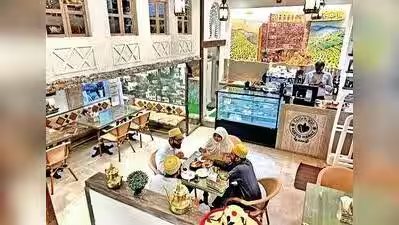
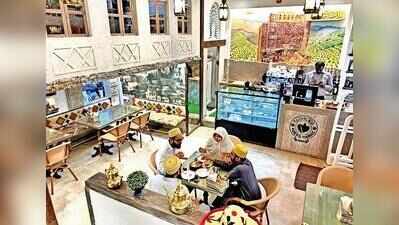
After a walk down the wide streets, shopping and eating piping hot payas, naans and kebabs, sitting down for some Yemeni coffee can be a nice way to wrap up the outing.Located near Raudat Tahera, the iconic mausoleum housing revered tombs of Dawoodi Bohras’ spiritual leaders Syedna Taher Saifuddin and Syedna Mohammed Burhanuddin in Bhendi Bazar, is a small coffee shop that resembles a piece from Yemen in West Asia of the Arabian Peninsula. Besides coffee, it also serves a mission.Its wooden window frames, stained glass engravings, rustic look of the walls, ceiling and floor, poems in Arabic calligraphy decorating a wall with English translation eulogizing coffee, all help transport you to a Yemeni home.Part of an upliftment project to help Yemeni farmers give up growing qat or khat, a plant whose leaves locals consume as a recreational stimulant, and cultivate coffee instead, the establishment brews hope.Concerned at the deleterious effects of widespread consumption of qat among Yemnis, late Syedna Mohammed Burhanuddin, the 52nd Dai or spiritual head of the Dawoodi Bohras, suggested coffee plantations replacing qat. Haraz, a mountainous region around 90 kms from Yemen’s capital Sana, was initially chosen for the pilot project.“Here farmers were told about harms of qat to their health and economy (the plantation consumes plenty of water and drains resources) and benefits of coffee cultivation. In a few years, the locals’ health improved and economy boomed,” says Shabbir Jabeli, a member at the Aqeeq Haraz Bunn, the company which runs the coffee shop as part of the upliftment project for the Haraz farmers. Jabeli adds that Syedna Mufaddal Saifuddin, the current spiritual head, has blessed the project as it weans Yemen’s farmers away from harmful qat and provides a healthy and profitable alternative cash crop, the Yemeni coffee, considered one of the best in the world.Since Bhendi Bazar is being redeveloped into a clean, traffic-free, infrastructurally rich locality by SBUT, this coffee shop connects the Dawoodi Bohras to Yemen which remained seat of the Dawat (community headquarters) from the time of the first Dai for nearly four hundred years. The spiritual leadership had moved to Yemen following the collapse of the Fatimid rule in Egypt in 1171.How did Bohras’ bond with Yemen grow? The 23rd Dai Syedna Mohammed Ezzuddin appointed Syedna Yusuf Najmuddin as the 24th Dai in 16th century in India, which marked the shift of the Dawat from Yemen to India. With Syedna Jalal Shamsuddin (25th Dai), the headquarters firmly established in Ahmedabad in Gujarat. After moving to many cities in West and Central India, the Dawat eventually settled in Bombay (now Mumbai) in the late 19th century.If Dawoodi Bohras have such a strong bond with Yemen, this coffee shop which also serves several authentic Yemeni dishes, helps strengthen the ties. The café manager Taha Petlawdaawala orders some of the dishes for us. Soon comes shafoot, a savory, chilled yogurt-based salad layered with spongy, fermented flatbread and spicy green herbs, bint al-sahn (daughter of the plate) Yemeni pastry, lahsa, a rich creamy egg dish cooked with spiced tomato base and a Yemeni stew.“Lahsa is a breakfast staple served hot with warm pita and flatbread,” explains Ibrahim Ismail Furniturewala, the chef who studied Culinary Arts in Singapore. “I have read up the recipes, watched videos and prepares authentic Yemeni cuisine,” claims the chef. “We have another branch opposite Al Jamea Tus Safiyah, the community educational institution, in Surat.”With the joint’s popularity growing, it attracts both Bohras and non-Boharas. “As I sat there, sampling authentic Yemeni dishes and drinking coffee which came with dates, I thought I was hosted at a Yemeni home. The ambience is very appealing with its sofa, low tables and an adjoining gift and souvenir shop making the experience memorable,” gushes local MLA Amin Patel after a recent visit.