






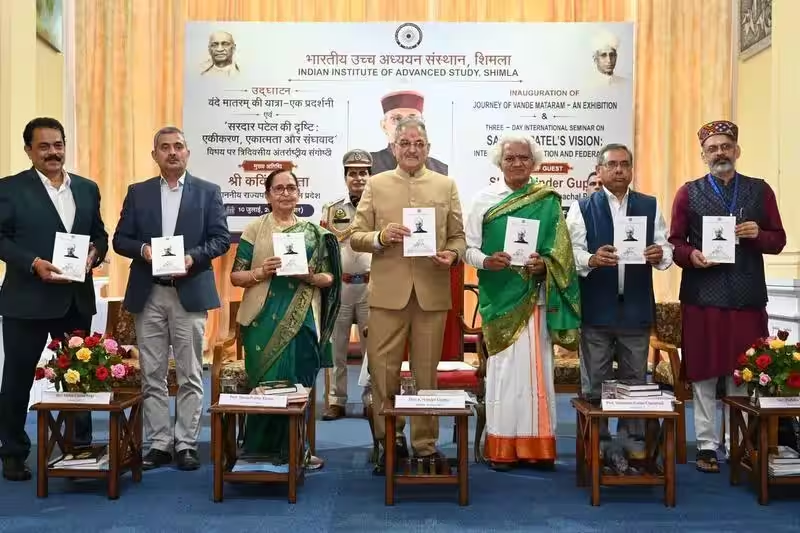
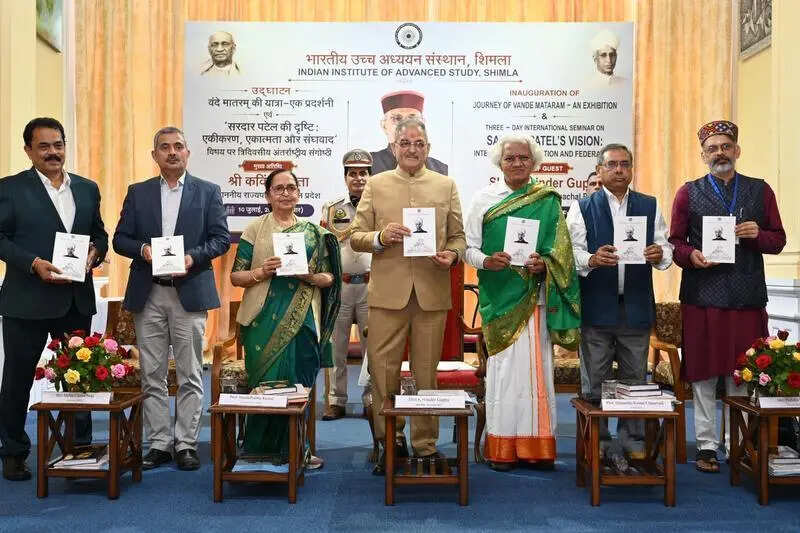
Shimla: Highlighting the enduring relevance of Sardar Vallabhbhai Patel’s vision, Himachal Pradesh governor Kavinder Gupta on Friday described India’s first Deputy Prime Minister as not only the architect of the nation’s political integration but also a steadfast advocate of Indian federalism.Addressing the inaugural session of the three-day international seminar on ‘Sardar Patel’s Vision of Integration, Integrity and Federalism’ and the inauguration of the ‘Vande Mataram: Ek Yatra’ exhibition at the Indian Institute of Advanced Study (IIAS), Shimla, he underlined that India’s federal framework remains unparalleled, seamlessly uniting diverse languages, cultures and traditions under the Constitution — the cornerstone of the country’s unity and democratic strength.Describing ‘Vande Mataram’ as the soul of India’s freedom struggle, Gupta said that Bankim Chandra Chattopadhyay’s immortal composition inspired generations of freedom fighters with the spirit of sacrifice, patriotism and national service. The governor released the coffee table book on Vande Mataram, the seminar proceedings on ‘Darsana of Radhakrishnan: Eternal and Temporal’, and a multilingual poetry volume on Sarvepalli Radhakrishnan. Prosperous nation through ideas“Innovations can make a nation prosperous but a nation can become truly great only through ideas,” said vice-president of India CP Radhakrishnan, in a video message after inclement weather prevented him from attending the inauguration in person.Drawing a parallel between India’s freedom movement and its journey of nation-building, he said if Vande Matram inspired the birth of our nation, it was Sardar Patel who transformed the scattered princely states in India into united republic. Marking the 150th anniversary of the timeless national song, Radhakrishnan said the occasion serves as a reminder that patriotism extends far beyond moments of struggle. It is reflected every day in the pursuit of excellence, dedication to duty, and the collective commitment to national unity.He stated that he is confidant that the permanent exhibition in IIAS will serve as a lasting source of inspiration, especially for the younger generation.‘Integrationist and not just unifier’Giving food for thought by citing examples, senior journalist and researcher Prafulla Ketkar, the keynote speaker, said he hoped that the experts during the conference will try to explore numerous “academically untouched” dimensions of Sardar Patel as an “integrationist and not just unifier”. He argued that remembering Patel as an integrationist, rather than simply a unifier, would naturally revive the spirit embodied in Vande Mataram.Questioning a widely accepted academic narrative, Ketkar said the notion of Bharat as “unity in diversity” often creates the impression that we are essentially diverse and unity is a project. “While the entire idea of Bharat has been different which Sardar Patel was very much clear that we are inherently united and diversity is the external expression,” emphasised Ketkar.He added that when the ‘centralised Union and decentralised administration’ was the original vision, why the country could not translate it and what Patel used to think about it, should be deliberated upon.Challenging status quoInvoking the founding ideals of the IIAS, its director, professor Himanshu Kumar Chaturvedi, quoted the institute’s inaugural address delivered by India’s second President Sarvepalli Radhakrishnan in Oct 1965: “We should not be the prisoners of the status quo.” In his welcome address, Chaturvedi highlighted the institute’s academic initiatives, saying IIAS continues to advance along the intellectual path, fostering critical research and fresh perspectives.Professor Shashi Prabha Kumar, chairperson of IIAS, recalled an observation from the diary of India’s first President, Rajendra Prasad: “That there is today an India to think and talk about is very largely due to Sardar Patel’s statesmanship and firm administration. Yet we are apt to ignore him.” She noted that this historical neglect is now being addressed through sustained scholarly engagement. MSID:: 132312560 413 |