










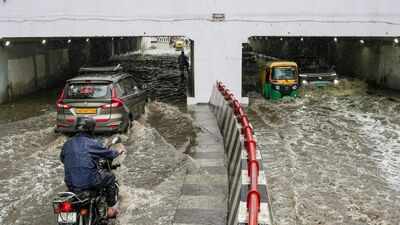
NEW DELHI: Barely 10 days ago, Delhiites were struggling through oppressive heat and humidity, with the “feels-like” temperature soaring well above the actual mercury. The city baked under stagnant air, sticky conditions and delayed monsoon showers, forcing residents indoors.Fast forward to this week, and the weather has flipped dramatically.The capital is now battling relentless monsoon rain that has flooded roads, uprooted trees, damaged buildings, paralysed traffic and prompted the India Meteorological Department (IMD) to issue a ‘red alert’ for heavy rainfall accompanied by thunderstorms and lightning.The dramatic turnaround has left many wondering: What changed so quickly?According to weather experts, the answer lies in the interaction of multiple weather systems — a Western Disturbance, the southwest monsoon, a low-pressure area over central India, and a northward shift of the monsoon trough — all converging over north India at the same time.A rare convergence of weather systemsThe widespread rain over Delhi is not being driven by a single weather event.Krishna Mishra, a scientist at the India Meteorological Department (IMD), explains that the interaction of a Western Disturbance, the monsoon trough and the weakening of a depression released enormous amounts of moisture into the atmosphere, leading to widespread rainfall not only over Delhi but also across Haryana, Punjab and Uttar Pradesh.Adding to this, Mahesh Palawat of Skymet Weather had earlier explained that the continuous rainfall resulted from the interaction of a Western Disturbance over northern Pakistan, an intense low-pressure area over central Madhya Pradesh and moisture-laden monsoon winds from the Arabian Sea.Instead of acting independently, these systems reinforced one another, creating ideal conditions for prolonged and widespread rainfall across the Delhi-NCR region.What exactly is Western Disturbance?A Western Disturbance is a weather system that generally originates over the Mediterranean region and moves eastwards towards northwest India through Pakistan.Although it is more commonly associated with winter rainfall over north India, an active Western Disturbance during the monsoon can significantly enhance rainfall when it interacts with moisture-rich monsoon winds.In Delhi’s case, the Western Disturbance supplied additional atmospheric instability just as the southwest monsoon was strengthening over north India.The monsoon trough shifted northWeather experts have also attributed the persistent rain to the seasonal monsoon trough shifting northwards from central India towards the Himalayan foothills, according to the IMD.As the trough moved closer to Delhi, it concentrated moisture over the region, allowing rain-bearing clouds to develop repeatedly instead of moving away quickly.The IMD has said Delhi is likely to continue receiving widespread rainfall until this weather system shifts further north, after which rainfall intensity is expected to reduce.Moisture from the Arabian Sea added fuelThe southwest monsoon has now covered the entire country after advancing into the remaining parts of Rajasthan, Haryana, Punjab and Delhi.As the monsoon advanced northwards, moisture-laden winds from the Arabian Sea continuously supplied water vapour into the atmosphere.When this abundant moisture encountered the Western Disturbance and the low-pressure system over central India, rainfall intensified across the capital.Why has the rain been so widespread?The rainfall has not been confined to isolated pockets because several weather systems became aligned simultaneously.The weakening low-pressure area over central Madhya Pradesh continued releasing moisture, while the Western Disturbance enhanced atmospheric instability. Combined with the northward-moving monsoon trough and strong monsoon winds, the result was widespread rainfall across Delhi and neighbouring states.According to the IMD, rainfall above 64.4 mm in 24 hours is classified as heavy rainfall. Safdarjung recorded 72.6 mm during the 24-hour period ending Thursday morning, while Lodhi Road received over 80 mm, confirming the intensity of the spell.The impact on DelhiThe heavy overnight rain uprooted several trees, damaged vehicles, flooded roads and disrupted traffic across the city.A four-storey under-construction building in Rohini collapsed amid the rain, killing three people after an overnight rescue operation, according to PTI.Neighbouring NCR cities also witnessed severe flooding. Roads were submerged in Noida, while Ghaziabad’s Indirapuram and Abhay Khand areas experienced extensive waterlogging, forcing commuters to wade through knee-deep water.The IMD responded by issuing a red alert, warning of continued moderate to heavy rainfall accompanied by thunderstorms and lightning.The IMD has indicated that rain activity is likely to continue until the interacting weather systems weaken and move away.